Some General Observations and Comments About Kirt Personality Traits
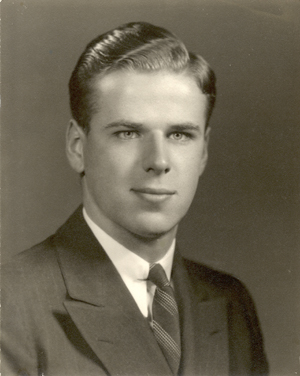
Kirt was always quite self assured and confident in his dealings with others but not to the point of being pushy or overly cocky. He was polite yet assertive, straight forward, firm, and generally to the point in his conversations and was never sneaky or conniving. He often injected a little humor into his conversations and he enjoyed telling a good joke or story to make a point or have a little fun particularly when socializing with friends, something he enjoyed doing in his spare time. He was not particularly shy and made friends reasonably easily. He always took a practical and not an emotional approach to just about everything and was always squarely rooted in reality with fantasy playing no particular roll in his life. He was always organized in his life and dealings with others and tended to take responsibility for whatever he did. He didn't spend a lot of time blaming others for things that went wrong, he'd just go about making things better. He wasn't particularly philosophical about life, he just went about enjoying it to it's fullest. He tended to be project oriented and results driven and didn't fritter away or waist time. He worked hard and played hard. He was always interested in what could be accomplished and didn't dwell on things that didn't directly concern him or that he had no control over. He always knew what he wanted and was intelligent and educated enough to figure out how to get it. I don't think the words "self doubt" existed in his vocabulary.
Kirt, while always pushing himself to accomplish more and encouraging others to do the same, was always even tempered and I don't recall him ever losing his temper even in stressful situations. He could be calm under pressure and could be very patient in situations where it was required. He would occasionally spank us kids when we were really bad (a common parenting tool as I was growing up) but generally preferred to use the "carrot" and not the "stick" method of motivation. He was always supportive of whatever us kids wanted to do so long as it was legal and productive even if it was in an area in which he had no particular interest himself. He never pushed his children to follow in his footsteps. He was neither superstitious nor religious though he had no apparent objections to organized religion and respected its place in society. The only times I believe Kirt ever ventured into churches were for an occasional wedding and/or funeral service even though during the 1950's his wife Betty attended an Episcopal church each week and took us kids to Sunday School regularly.
I strongly suspect that Kirt was a registered member of the Republican political party his entire life though I don't know this for a fact. (He was a registered Republican at the time of his death). He didn't spend a lot of time talking about the politics of the day though he did have his opinions and always voted on election day. He generally accepted other's for what they were and wasn't unusually judgmental with the exception that he wasn't particularly supportive of those who would not help themselves. On the other hand he could be very supportive of anyone willing to work for their own betterment. He thus didn't like government welfare programs that provided un-earned handouts to anyone but liked the ones that required people to work for government social benefits. Kirt didn't particularly discriminate against anyone (at least not by the standards of the day) based on race, religion, or background, but he didn't have a lot of respect for anyone not willing to be a productive member of society.
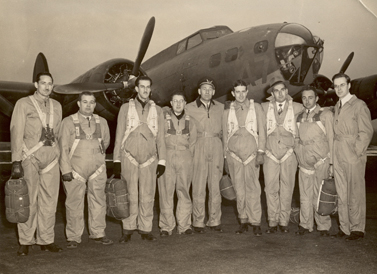
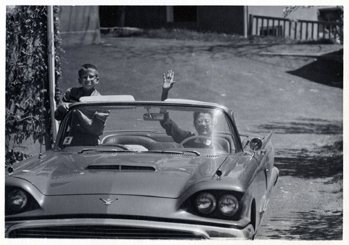
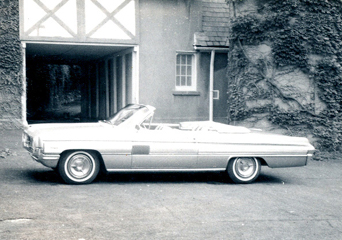
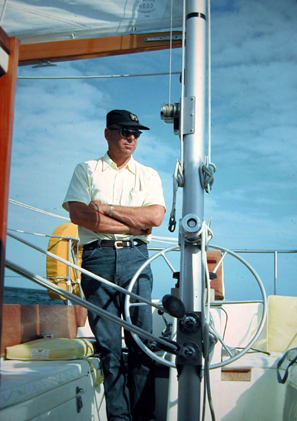
Kirt was never particularly obsessed with status symbols as such and most of his personal possessions throughout his life were functional in nature even in his later life when he could afford more expensive things. He tended to own things because they functioned well and not because they were glamorous status symbols though he had no objection if something were both functional and glamorous at the same time. He never purchased or collected art for art's sake. The fancier cars he could afford and purchased later in life were not necessarily the fanciest ones available but had functional features which appealed to him. Even his yacht Marigo wasn't intended to be glamorous as such but rather was configured to be the best and most functional cruising sail boat in the Caribbean. Kirt was also not a fancy dresser. He was usually required to wear a business suit to work during his Curitss-Wright days but when not on the job in the 1940's and 1950's he almost always wore his trademark denim blue jeans, a white dress shirt, and white sneakers. In later years I'm not sure he even owned a suit. For the occasional more formal event he attended he'd wear a sport jacket and slacks. But the vast majority of the time during his Marigo years he simply wore shorts (often cut-off blue jeans) and a sport shirt. Regarding automobiles, Kirt's firt car was a Buick he bought shortly after going to work for Curtiss-Wright which he used through World War II. During the years of his first marriage the family always had a reliable station wagon to get the family around (including a 1955 Buick and then an early 1960's Oldsmobile). However for many years during the 1950's he had a very used and clunky Morris Minor primarily to make the short commute to work in. It was tiny and resembled the now famous Volkswagen Beetle. When he could afford it after retiring he purchased a 1959 Ford Thunderbird (4-seater) convertible which turned out to be a troublesome "lemon" so he traded it in for a 1961 Oldsmobile Starfire convertible. Shortly after moving to Garrison, NY he traded the Starfire for an Oldsmobile Jetfire coupe, a smaller car which I recall was the first production consumer automobile to be "turbo-supercharged". This would have appealed to Kirt's engineering background thought turbocharged cars never caught on. Around 1967 Kirt purchased a convertible Chevrolet Chevelle Malibu which he drove till he bought a Mercedes 240D diesel shortly after moving to Florida. Kirt always signed his name on bank checks "E. K. Hine". On more formal documents he signed his full name. When he wrote letters to his sons they were usually signed "Pop" and letters to others were signed "Kirt". Medical History Till his diagnosis with pancreatic cancer in late 1976 Kirt had been, with only a few exceptions, generally healthy his entire life. I believe, but can't say for sure, that Kirt had both his appendix and tonsils removed when he was a child. If they weren't removed, they never caused problems in his later life. To the best of my knowledge he was never allergic to anything. I can't recall him ever being bedridden with any illness and he rarely, if ever, missed work with a cold or the flu.
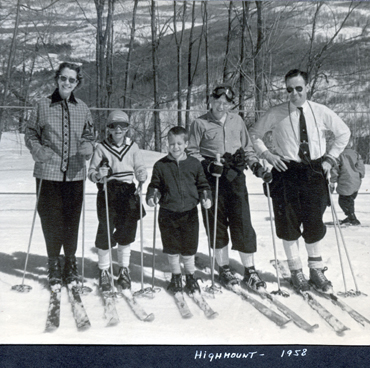
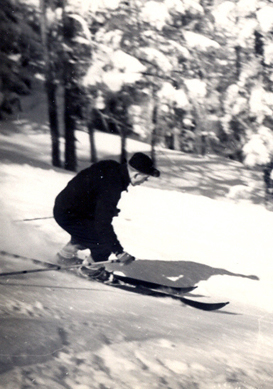
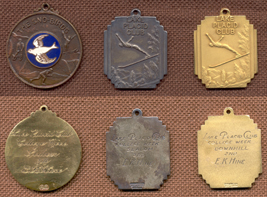
In his youth and particularly his ski racing days throughout college Kirt certainly maintained a high level of physical fitness. After that, while I can't say he wasn't physically fit, he wasn't much of an active athlete. With the exception of our family ski trips from the mid 1950's till the early 1960's Kirt never did anything actively physical or which today we would call "aerobic" in nature. On the other hand Kirt was certainly not sedentary in any way as he was always up and about doing something. In his later years aboard Marigo there was always something to do which required at least moderate physical activity and dexterity. Starting in the early 1960's in New Jersey and continuing on into his Marigo years Kirt regularly did a set of daily exercises made somewhat famous by the Royal Canadian Air Force. The exercises, explained in a small booklet, took about 10 minutes a day and involved doing a few exercises such as deep knee bends and push-ups intended to provide a minimal level of fitness for those who otherwise had sedentary jobs or lifestyles. Kirt never had a weight problem and maintained his idea weight naturally by simple eating what he wanted. He usually ate a healthy, well balanced, diet (by the standards of the day) and did not consume excessive quantities of what we today call "junk-food".
Kirt's one chronic medical problem was heartburn. (His condition may have been what today is known as acid reflux disease.) For all the years I knew him from my childhood till his death he regularly took a brand of antacid tablets known as Gelusil multiple times each day. He bought them in bulk packages and always had small individually wrapped plastic sheets of them in a pants pocket. Several times a day he'd subconsciously reach in his pocket and pop one of the white tablets in his mouth and chew it thoroughly before swallowing. He never complained or talked about his heartburn apparently because taking the antacid tablets quickly and effectively solved the problem.
He was a heavy cigarette smoker and drinker of alcoholic beverages all of his adult life. Except for the common minor "smoker's hack" (cough) his 2+ pack a day cigarette habit had no noticeable medical effect on Kirt. In later life his social drinking habit apparently crossed the line into mild alcoholism but otherwise had no obvious effect on his health. Around the time of Kirt's death there was some speculation in the medical community that regular consumption of alcohol may have been a contributing risk factor for pancreatic cancer but as I write this a check of internet medical web sites doesn't show alcohol as a risk factor. Contributing factors currently listed for pancreatic cancer which may have effected Kirt include smoking (twice the normal risk but probably not significant in Kirt's case), eating meat and fatty foods (though his diet wasn't different from that eaten by most Americans during his life), and long term exposure to gasoline and related oil based compounds, which, looking back at it, could have been a factor in Kirt's case. Most of his life Kirt was regularly directly or indirectly exposed to gasoline or related forms of fuel as part of his career in aviation, his nautical recreational activities, and his hobbies. He always seemed to have his hands covered with some oily mess which he regularly used gasoline to clean.
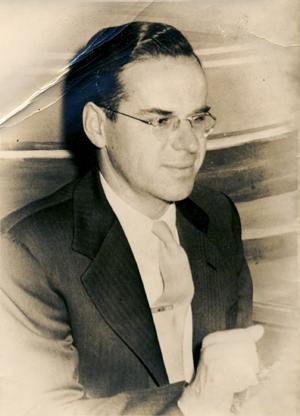
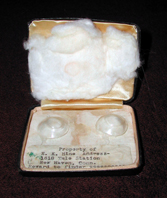
Kirt was quite nearsighted and always wore glasses to see clearly at a distance. In his later years he wore bi-focal eye glasses so he could also see to read. While at Yale in the late 1930's he took part in a test of very early contact lenses which were huge by today's standards and which covered the entire eye including the white area around the pupil. They evidently hurt so much to wear that he used them only when racing when wearing his glasses could cause fogging problems. He could apparently only stand to wear them when it was cold out and he was active. By the late 1960's small and much more comfortable contact lenses were readily available but to the best of my knowledge Kirt never wore or even tried them. The one hospitalization I recall Kirt having as an adult was in the early 1950's and my recollection of it is more from hearing about it in later years than from my direct memory of it as a young child. Kirt apparently started experiencing severe back pain and was diagnosed with a disk problem in his spine. The doctors said it could easily be fixed with a simple operation and that when he awoke after the surgery he would be fine and experience no pain. During the surgery the doctors found that their diagnosis had been wrong and that the problem was in fact some kind of a growth on Kirt's spine which they literally scraped away during the operation. When Kirt awoke from the anesthesia he was in extreme pain for a few days while the effects of the growth's removal healed. Kirt never again had any problems with his back. In the 1930's (and long before the age of safety release ski bindings) Kirt managed to become one of the top competitive ski racers in the nation without ever breaking a bone (though he did regularly manage to pull some muscles and/or tendons in his thumbs from holding his ski poles so low to the ground that he would catch them in the snow during races). In the mid 1960's however he accidentally broke a lower leg bone while trying to balance on my new skate board on the absolutely flat driveway at his Garrison, NY home. He fully recovered after 6 or 8 weeks in a cast. Sports, Hobbies, Interests and Other Activities
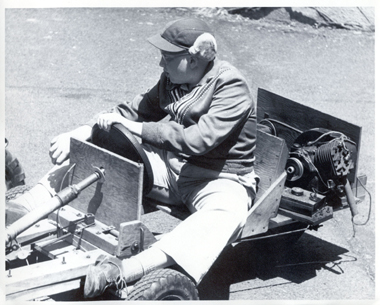
Kirt had played football in high school and excelled at skiing and sailing during his lifetime but he had little interest in other sports. I recall seeing him water ski a couple of times and he could play a little golf thought he never did so unless a social situation required it. He fly fished during the late 1950's and early 1960's but he tended to be more interested in the equipment than in actually catching the fish. As a spectator he would occasionally attend (and sometimes take the family to see) a Yale football game but he did this more as a social event with old friends and an opportunity to support his alma mater than because he was a football fan. I don't recall him ever being a fan of any of the common professional spectator sports such as baseball, football, hockey or basketball though he did take me to at least one professional baseball game (at Yankee Stadium in New York City) and one hockey game as a child probably only to expose me to the sports and do something with his son. Kirt never played cards or board games (much to the frustration of his first wife Betty who loved to play Bridge), almost never went to movies or watched television (except for live public interest events such as the 1969 Apollo mission to the moon) I suspect because he was more interested in doing things himself than in watching others do them. Kirt would very occasionally attend Broadway plays and, less frequently, visit a museum or other cultural event but this was usually because of social pressure more than because he really was interested in such things. He never collected things like stamps or coins and his personal possessions tended to be functional and useful in nature rather than decorative. When he wasn't working, Kirt spent his spare time mostly socializing (with a cocktail and cigarette in his hands) with family and/or friends or working on his projects such as home improvements, go carts or radios for his kids, or, in later years, Marigo. He tended to like to tinker with things that required both a mental and a physical hands-on challenge.
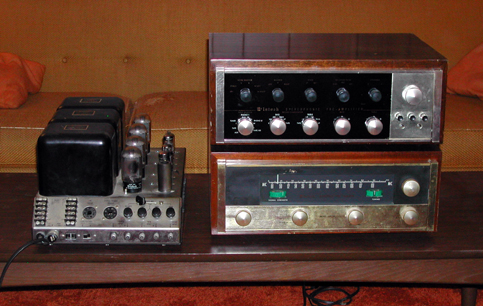
Kirt was never a fanatic about music but did enjoy occasionally listening to some of the big band music of his younger days and the sound tracks of some 1950's Broadway plays. During most of the 1950's the family had an inexpensive AM/FM radio and turntable combination in the North Caldwell living room which was used mostly to play background music for social occasions. When Kirt could afford it in the late 1950's he "invested" in a very expensive McIntosh brand component stereo system which was considered the state-of- the-art in high fidelity sound reproduction in its day (and still is by some serious audiophiles). This "investment" was much more of a reflection of Kirt's interest in the technology involved than in his interest in music as such. My father was never a voracious reader. I don't recall ever seeing him sit down and read a book just for pleasure or relaxation. He did subscribe to and read an occasional magazine, particularly one relating to his interests of sailing, skiing, or radio and he certainly read technical manuals in detail. I think it possible that Kirt was never a fast reader (though he was certainly a thorough one) though I don't know this for a fact. Kirt had no trouble traveling when he had to or wanted to though he would do so only as a means to an end, not as a form of recreation in and of itself. Thus he wasn't much of a "tourist" by nature. With the exception of his Marigo years and an occasional trip into Canada in his younger days Kirt never traveled internationally and thus never visited Europe, Asia or any other continent. Kirt took Marigo to many glamorous destinations but he didn't go there to a be tourist. His motivation was always to be playing with his yacht and being in any particular destination was secondary to the process of getting there. Sense of Family Kirt had a reasonably strong sense of family and stayed close to his father, mother, and sister (and her family) even though for most of his adult life he lived far from them. He visited his Pacific Northwest childhood home almost annually from when he left home to attend Yale in 1935 till his mother passed away in 1967.
He knew and stayed in contact with his Ohio Hine and Kirtland relatives and knew a lot about about his ancestors there from taking with these relatives. He was closest to his "Uncle Kirt" (Samuel Kirtland Hine) but also knew well all his father's other siblings and their children (his first cousins). While Kirt knew his father's Ohio relatives and thus knew of his ancestors on this side of his family, he interestingly virtually never talked about his mother's Turner family. I never thought about nor noticed this omission till I started doing genealogical research on my ancestors and realized that I knew absolutely nothing about my grandmother's ancestors. I don't know why Kirt never mentioned them. Perhaps it was because he didn't know them (though I've learned recently that Kirt had Turner uncles and first cousins in Idaho which was geographically much closer than his Ohio relatives). But why he wouldn't have known them is a mystery. Perhaps for some reason Kirt's mother wasn't close to her Idaho relatives and therefore didn't mention them to him much.
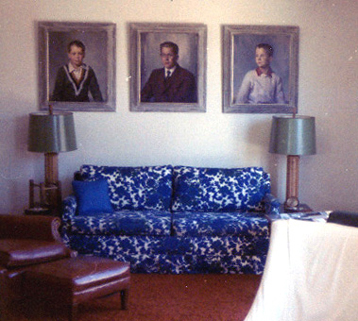
Even thought Kirt lived a continent away he always made sure his parents were taken care of, particularly his mother after his father's 1958 death. Shortly after his father's death Kirt commissioned our North Caldwell, NJ neighbor (and regionally noted artist) Lawrence Wilbur to create paintings of myself and my two brothers. The completed original large oil paintings were shipped to Kirt's mother as a present so she could have quality images of her grandchildren. They hung in her living room till her 1967 death. Once when visiting Seattle after his father's death Kirt perceived the need for his mother to have better transportation to get around Seattle in as the old family car was apparently long past it's prime. (By this time Rose Hine no longer drove but was driven around by her full time live-in caregiver.) So Kirt went out and bought a brand new Mercedes Benz for his mother (I assume with her money). Kirt often told the story of how he picked up the new Mercedes at the dealership while on his way to play golf with a childhood friend. As he entered the driveway of his friend's country club the transmission of the brand new expensive automobile partially fell out making the vehicle un-drivable (apparently as a result of an oversight at the factory). The way the story goes Kirt simply walked the rest of the way to the club house, called the Mercedes dealer, and went about playing a round of golf with his friend. By the time they had played all 18 holes, the dealer had picked up the defective Mercedes, transported it back to the repair ship, fixed it, and delivered it back to the country club where it was waiting when the golf round was over. This may explain why in later years Kirt would purchase his own Mercedes.
Heirlooms and Artifacts Kirt generally didn't collect or keep possessions for the simple sake of owning them. Because of this and his recent divorce from Mary shortly before his death, he didn't pass on many physical possessions to his sons. There was no house full of family furniture, china, silverware, hobby collections and the like. The few emotionally valuable physical possessions Kirt did have at the time of his death consisted largely of things that had some direct personal meaning to him and/or had been passed on to him from his ancestors.
Below I have documented the surviving items which
I believe have ancestral
sentimental value and/or are likely to be of interest to
future generations. I've organized them into 2 major categories,
those items which were passed on to Kirt by his ancestors and those that
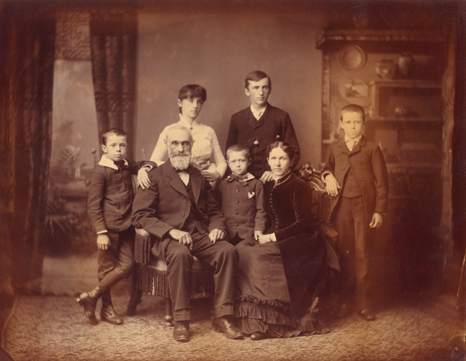
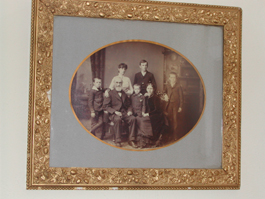
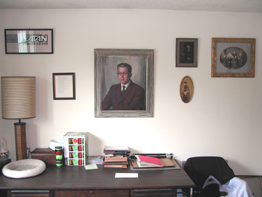
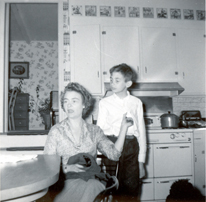
originated with him. Samuel Hine Family Portrait This ornately framed photographic portrait of the Samuel Hine family was taken around 1880 in the old Hine home at 441 South Main St. in Poland, Ohio. Samuel Hine was Kirt's grandfather. I'm not exactly sure when Kirt came to possess this portrait but I suspect it came to him after the death of his uncle, Samuel Kirtland Hine, in 1942. A photo containing an image of the portrait taken in my childhood North Caldwell, New Jersey home shows it hanging in our dining room during the 1950's at a time likely before the death of either of Kirt's parents suggesting that it did not pass to Kirt from them. Today the original portrait hangs in my Louisville, Colorado den.
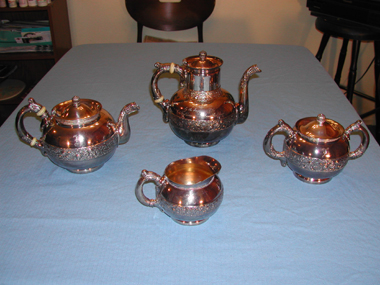
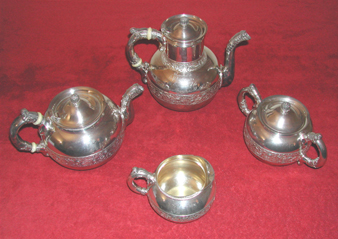
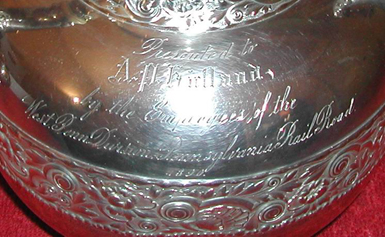
Alfred Potter Kirtland Silver Tea Set Alfred Potter Kirtland (1844 - 1927) was the brother of Kirt's grandmother Emma Kirtland-Hine. He was for a number of years the Superintendent of the West Penn Division of the Pennsylvania Railroad and lived as an adult in and around Pittsburgh, PA. The inscription on the largest pot of this 4 piece silver service set reads "Presented to A. P. Kirtland by the Employees of the West Penn Division, Pennsylvania Rail Road, 1890". Alfred Potter Kirtland had 2 children who both preceded him in death and he had no grandchildren. This explains why the tea set was not passed down his branch of the Kirtland family. In 1983, 5 years after Kirt's death, I received a letter from his sister Ruth Hine-Darling asking if I had the silver set (which I did). In the letter she gave a little of it's history explaining that Kirt's "Uncle Kirt" (Samuel Kirtland Hine), who had no children, had sent it to Kirt's parents in Seattle with the stipulation that Kirt eventually get it. When Kirt's mother Rose Hine passed away in 1967 Ruth sent the tea set to Kirt and it was understood that I would eventually get it being the only member of my Hine generation still carrying the Kirtland name at the time. Samuel Kirtland Hine likely obtained the tea set upon his uncle's death since Alfred had no living relatives of his generation in his later years and no living heirs. Ruth indicates in her letter that Alfred P. Kirtland was my great great grandfather which is incorrect. Alfred was my great great uncle (brother of my great grand mother Emma).
I don't recall exactly when I came to possess this tea set. Kirt likely sent it to me before he passed away but I don't remember this as a fact. As I write this I have it stored in a closet with other of my father's miscellaneous artifacts.
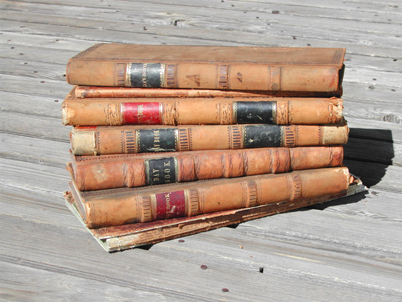
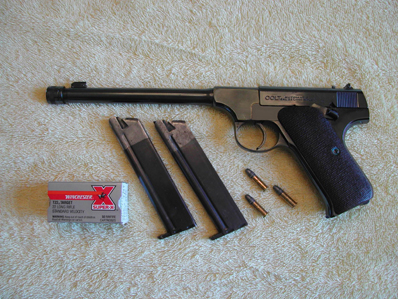
Samuel Hine's "Day Books" This 7 volume set of "day books" (as is engraved on the bindings) belonged to Kirt's grandfather, Samuel Hine (1816-1893) and were apparently used to account for the everyday sales and purchase transactions of his Hubbard, Ohio mercantile business during the period from 1845 to 1856. This was before his second marriage to Emma Kirtland in 1866 and the family's subsequent move to nearby Poland, OH. The books contain page after page of handwritten (and hard to read) entries including names, dates, descriptions, and dollar amounts. Kirt passed these books on to his son Greg who recently left them with me for long term storage with our father's other artifacts and heirlooms. Samuel Kirtland Hine's Colt 22 Caliber Pistol This Colt .22 caliber semi-automatic pistol belonged to Samuel Kirtland Hine (Kirt's "Uncle Kirt") and was inherited by my father after his uncle's death in 1942. I recall target shooting with this pistol a couple of times as a child during the 1950's under father's supervision on our New Jersey lawn when he would very occasionally bring it out and fire it. Father probably only fired it on 3 or 4 occasions over the years he had it and it was otherwise always stored away in a safe place and generally forgotten about. Since the gun passed to me after Kirt's 1977 death I've fired it recreationally on perhaps 3 occasions. It is in excellent working and physical condition and it is apparent that it has been rarely fired over the years. (A note to future generations: this gun should only be fired using "Standard Velocity" 22 Long Rifle ammunition and not using the newer and more common "High Velocity" ammunition which I've learned can cause damage to it.) I've recently done a little research on this gun and, based on it's serial number (#37213), have determined that it was manufactured around 1923. I assume that Uncle Kirt purchased it when new. It is currently referred to as a "Pre-Woodsman" model, a reference to the fact that it was an early model of the now famous Colt Woodsman series of 22 caliber pistols manufactured by Colt from 1915 to the early 1970's. This particular gun is rather unique and apparently very rear in that it has threads on the barrel muzzle onto which a silencer can be attached. I distinctly remember father having a silencer for it when we fired the pistol together in the 1950's but when I took possession of the gun after father's death the silencer was no where to be found and the barrels threads were covered by a simple screw-on cap. In the 1950's silencers were highly illegal (as I believe they continue to be today) and I suspect that Kirt stored the silencer separately from the gun and that it somehow became lost over the years. My research has uncovered only one limited reference to the fact that Colt ever manufactured a Woodsman model for use with a silencer and I have run into no other examples of such a configuration on gun collectors web sites. This, combined with the pistol's excellent condition, likely make it a very rear collectors item though I have made no attempt to value it. Update: In the fall of 2023 I passed this pistol on to the next generation by giving it to my nephew Richard Kirtland Hine ("Kirt"). The gun has now been owned by 4 generations of Hine's with the middle name Kirtland: Samual Kirtland Hine (Kirt), Edward Kirtland Hine ("Kirt"), Edward Kirtland Hine, Jr. ("Ted") and now Richard Kirtland Hine ("Kirt").
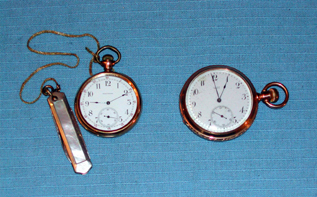
Homer and Samuel K. Hine's Gold Pocket Watches Among Kirt's other effects I have stored the gold pocket watches owned by his father Homer and uncle Samuel Kirtland Hine. At some point in time the crystal (the clear cover) of Homer's watch shattered. Kirt probably obtained his father's watch after Homer's 1958 death. I don't know whether Kirt obtained his Uncle Kirt's watch when his uncle died or when his father died. Homer's watch was made by Waltham and Uncle Kirt's is inscribed "Agassiz, Geneva". Update: Homer Hine's gold watch was passed on to my nephew, Charles Gordon Hine ("Charley") as a present after his 20126 marriage.
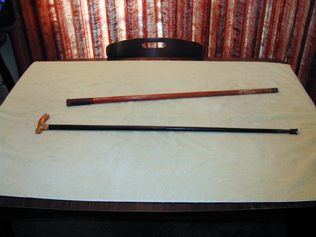
Uncle Kirt's Canes
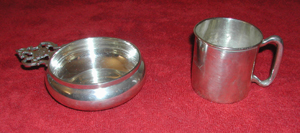
Items Which Belonged to Kirt: Kirt's Silver Baby Cup and Porringer I currently have Kirt's sterling silver baby cup and porringer stored with his other artifacts.
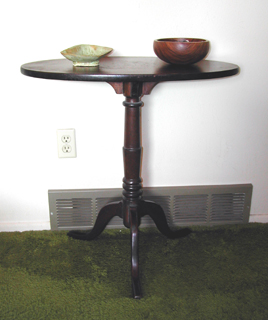
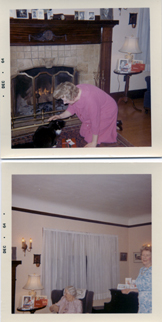
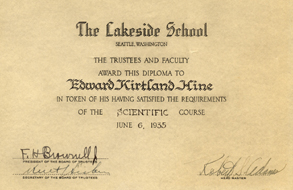
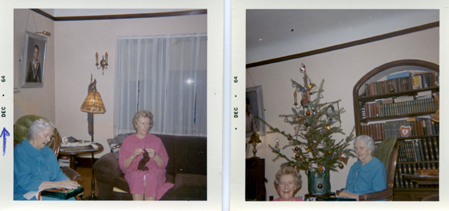
Handmade Queen Anne Style Table In the early fall of 1976 when Kirt was clearing his possessions out of the Florida home due to his pending divorce and moving aboard Marigo he called me one day and said he was shipping me a small Queen Anne style table he had no place to store. He explained that he had made it from scratch in a school woodworking class as a child. A few days later it arrived. After Kirt's death and for many years I was a little confused by this table as I didn't recall ever seeing or hearing about it in all the years I had lived with my father. A few years ago while organizing old family photos I stumbled on some which explained this minor mystery. Photos taken in 1964 in Kirt's childhood home in Seattle where his mother was still living show the table in the background. Apparently the table had been in the Seattle living room since Kirt made it, probably in the early 1930's while attending the Lakeside School. Kirt would have had it shipped to him after his mother passed away in 1967 by which time I was no longer really living much with father and thus wouldn't have noticed it or been told about it. Miscellaneous Items Some miscellaneous items which I currently have stored with Kirt's artifacts and have discussed elsewhere in this biography:
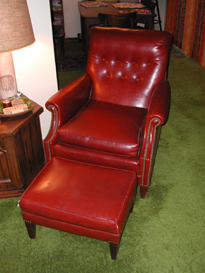
Favorite Leather Chair
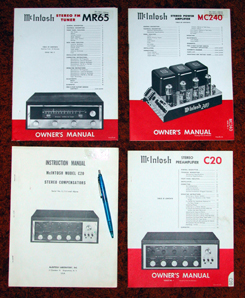
and Hassock McIntosh Stereo Component System In the late 1950's or early 1960's Kirt purchased a very expensive and state-of-the-art McIntosh brand stereo audio component system including a pre-amplifier, power amplifier, and AM/FM tuner which, like the leather chair described above, stayed with Betty after the 1962 divorce. (And like the leather chair, Kirt bought another similar setup which he used in the Garrison and Florida homes till he disposed of it I believe during the period he and Mary were getting divorced in 1976.) Betty used Kirt's stereo system throughout the rest of her life and I now have it in storage in my Colorado home. I hope to someday have the system, which currently needs some adjusting work done and probably new vacuum tubes, reconditioned and brought back to it's original specifications. Almost 50 years after it's initial design this early analog McIntosh model is still in demand by serious audiophiles and collectors and, while it is technically obsolete having been replaced by much smaller and less expensive digital systems, it is not yet functionally obsolete in terms of it's power output and frequency response.
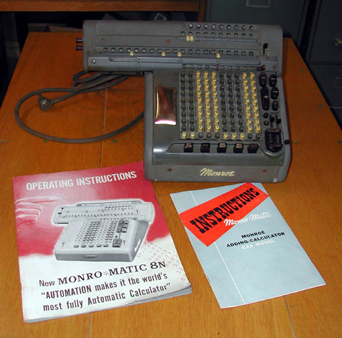
Engineering Calculator
After retiring from Curtiss-Wright Corp. in 1959 Kirt purchased a very sophisticated mechanical calculator for use in his E. K. Hine Company engineering work. It was state-of-the-art by the standards of the day and such calculator technology had only recently replaced the slide rule. It was very expensive (about $1,200 at the time as I recall, the equivalent of perhaps $5,000 today) and it made mathematical calculations using mechanical motors and wheels. It took quite a bit of time to learn how to use and would only perform addition, subtraction, multiplication, and division operations. I recall it taking quite a bit of time to perform division as it literally would keep subtracting the divisor from the original number till nothing was left as the wheels and motors made whirring and clunking noises. It was highly accurate to a number of decimal places and took the drudgery out of straight forward mathematical calculations though it couldn't do sophisticated mathematical functions. It wouldn't be functionally replaced till the advent of the readily available electronic calculator 10 or 15 years later. Kirt actively used this calculator for his engineering calculation till he fully retired in 1967 and thereafter had it in his home office where it was primarily used to balance his check book. Today I have it in storage.
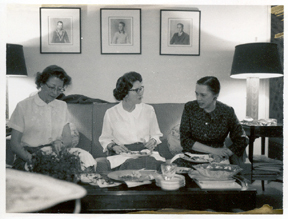
Oil Portraits of the Kids In 1959, shortly after the 1958 death of his father, Kirt commissioned our North Caldwell next door neighbor and regionally known artist Lawrence Wilbur to paint oil portraits of his 3 sons for his mother who, having recently lost her husband, was now living only with a full time caregiver in Kirt's childhood home in Seattle. I remember well sitting in Mr. Wilbur's nearby studio behind his home while he painted my portrait. When all three paintings were finished Kirt had black & white photographs taken of them before shipping the oil paintings to Seattle. The photos were hung in our North Caldwell living room and the original paintings hung in the Seattle living room till Rose Hine passed away in 1967. At that time Kirt gave the paintings to Betty, his former wife and mother of the painting's subjects. From then on my mother always had the painting hung in her homes in St. Louis, California, and finally Hermann, Missouri. After Betty's 1996 death Greg, Henry and I each took possession of our individual portrait. Today my portrait hangs in my Louisville, Colorado den.
In 1989 Henry Hine took some video footage of the three paintings hanging in the upstairs common area of Betty's Hermann, MO farm house. In the video Henry is talking to his son Charley.
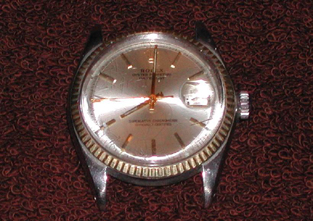
Rolex Chronometer Rolex continues to make and sell almost exactly the same watch today and such time pieces are now an extremely expensive status symbol. In the early or mid 1980's when I took the Rolex to a local jeweler for a cleaning and to be calibrated the store had one on sale exactly like it (including the gold trim) for just under $2,000 (which would be the constant dollar equivalent today of probably over $4,000 to $5,000). Since the watch was an unexpected gift to me it contains no inscriptions or special identifiable marks. Today I have it stored with my other small valuable items and important papers. When Kirt passed away in 1977 the wrist watch he was wearing was a Bulova Accutron (serial # 121583) which is currently stored with the Rolex. I do not know what ever happened to Kirt's second Rolex nor when and why he switched to a Bulova. Perhaps by 1977 Rolex's accuracy had been surpassed by the Accutron.
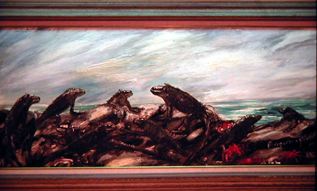
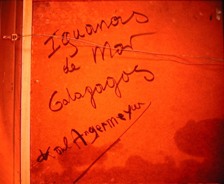
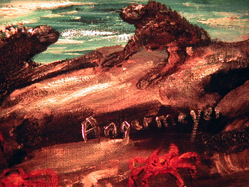
Karl Angermeyer Galapagos Oil Painting The oil painting of marine iguanas and a stark Galapagos land/seascape painted by Karl Angermeyer which was obtained by Kirt and Mary from Karl in January of 1971 and returned to Florida screwed to a bulkhead aboard Marigo behind the head door has hung in my Colorado Den since shortly after Kirt's death. I believe it was displayed in the living room of Mary and Kirt's Florida home from 1971 till their 1976 divorce.
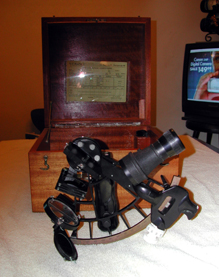
Kirt's Sextant While Kirt preferred to use his Loran receiver whenever possible to determine Marigo's position at sea, he was required to navigate using centuries old celestial navigation techniques when far from U.S. territorial waters and out of Loran transmitter range. Marigo carried a C. Plath sextant (made in Hamburg, Germany), a precision instrument and the acknowledged leader in the field at the time, to take sun and star sightings which, along with his Rolex watch, would provide raw data which he would then tediously mathematically refine to determine a line of position on a nautical chart. Today I still have this well used and somewhat salt encrusted sextant stored in it's original protective wooden case.
Marigo's Compass
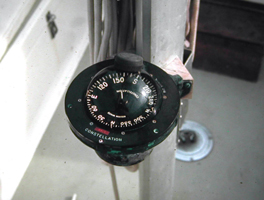
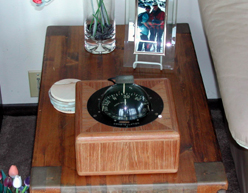
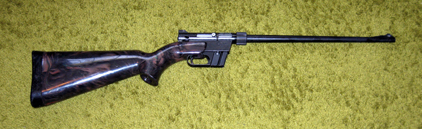
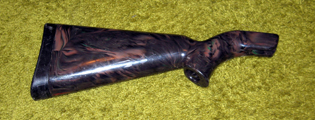
As with all indispensable equipment Kirt carried two main ship's compasses aboard Marigo. One was attached to the lower mizzen mast in the cockpit where it could be easily seen from the helm for day to day use in navigation. An identical one was kept in a storage locker in case the primary one failed for any reason. He always had them calibrated together and would swap them out periodically to make sure both were working properly. Kirt sold Marigo the day before he died but apparently one of these compasses was stored at the time in his shore locker. This compass came to Colorado with the rest of Kirt's effects where son Greg had a nice wooden display box made for it. Today it sits in the living room of Greg's mountain home overlooking Boulder, Colorado, far from sea level and any ocean. I don't recall Kirt ever replacing Marigo's primary compasses so I assume that this compass went everywhere Marigo did from her maiden voyage in 1967 to Kirt's death in 1977 and was likely in use as Marigo's primary compass for approximately half of this period. Armalite AR-7 Survival Rifle This .22 caliber Armalite AR-7 survival rifle was likely purchased new by Kirt in 1967 when he purchased Marigo. It was always on board and I remember using it a number of times when on sailing adventures, most usually to shoot at and sink empty soda or beer cans which we throw overboard as targets. It likely went everywhere Marigo did from 1967 through 1976 even though it was almost always illegal to enter foreign ports-o-call with a fire arm aboard. The collapsible design made it easy to hide deep in a storage locker somewhere and out of sight of customs agents when clearing into foreign countries.
The rifle has a semi-automatic action and the magazine holds about 7 or 8 rounds of ".22 Long Rifle" ammunition. It is designed to come apart with the barrel, action, and magazine fitting into the plastic stock. A rubber cap on the shoulder end of the stock was designed to be waterproof so the rifle would not get water damaged in an emergency situation and would float. It only takes a minute or two to remove the components from the stock and make the rifle functional. No tools are required. A little research shows that the rifle was designed by Armalite in the late 1950's for the military though it quickly made it into the civilian market. Substantially the same design is still in production today by several companies other than Armalite which sold the design in the 1970's. After Kirt passed away I stored the rifle in my Colorado garage for almost 30 years till in 2006 I came upon it and pulled the components out of the stock for probably the first time since it had been aboard Marigo. It was a mess and, in addition to looking like Kirt had never cleaned it in all the years that he and his guests had used it, the barrel and action were encrusted in places with white corrosion, likely from exposure to salt water many years before. I suspected that the rifle would probably never work again but I cleaned it up anyway by first soaking all the metal parts in a solvent for several days and then giving it a standard but thorough rifle cleaning and oiling. It cleaned up nicely and when I took it to the range, it worked reasonably well. The only problem was with the magazine which wouldn't feed at all, I suspect from physical damage inflicted long ago. I was able to purchase a new magazine which, while it still occasionally jams, works much better. The rifle is again pretty much fully functional with the exception that the years have dried out the hard rubber stock cap and I suspect that it is no longer waterproof. Books
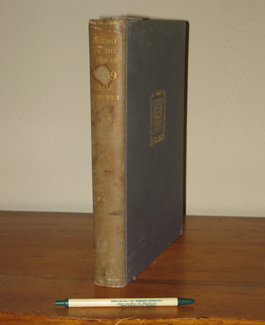
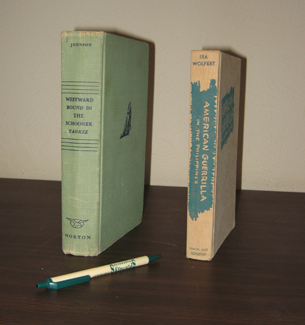
Kirt almost never read books for pleasure or relaxation. After his death very few were found among his possessions and most of those he had kept over the years were technical reference books from his E.K. Hine, CO days which I discarded as being of no particular interest to anyone and technically obsolete. I do have 3 books which belonged to Kirt. "The History of the Class of 1939 - Yale University" (his college yearbook which he kept for obvious reasons), "Westward Bound In The Schooner Yankee" by Irving Johnson, and "American Guerrilla In The Philippines" by Ira Wolfert. The fact that Kirt kept the two novels suggests that they likely had sentimental or emotional value to him but I can only guess as to why. "Westward Bound" was published in 1936 and tells the tale of one of Irving Johnson's many famous adventures sailing around the world. I suspect that Kirt may have read this copy of the book in his college days and that it may have been partial inspiration for his full time interest in blue water sailing during his retirement. "American Guerrilla", published in late 1945, is a little harder for me to explain. It tells the story of an American working behind enemy lines in the jungles of the Japanese occupied Philippines during World War II. My best guess is that the book was given to Kirt in the 1950's sometime after his brother-in-law, John A. Nalley, married Betty's sister Harriet in 1953. John Nalley had in fact been a guerrilla working behind enemy lines in the Philippines during the war as a part of General Douglas Macarthur's intelligence staff helping organize the natives to pave the way for the General's now famous return to these islands. I vaguely recall hearing John's story from my parents a number of times when I was young and later from my mother after Kirt had passed away. John had been inserted into Japanese held territory (I believe by parachute) due to his ability to quickly learn the local native language. He was later seriously wounded in the leg by Japanese's gun fire and had been clandestinely evacuated from the Philippines on a U.S. submarine. I recall hearing that John's adventures as a guerrilla were partial inspiration for several post war books and a Hollywood movie, though none of these was actually a direct factual story about him. I've scanned (but not thoroughly read) "American Guerrilla" a couple of times since Kirt's death and can't find anything in it that directly sounds like John's experiences the way I recall hearing them. I can only guess that perhaps somewhere in the book the author mentions John in passing.
|
|||||||||||||||||||||||||||||||||||||||||||||||||||||||||||||||||||||||||||||||||||||||||||||||||||||||||||||||||||||||||||||||||||||||||||||||||||||||||||||||||||||||||||||||||||||||||||||||||||||||||||||||||||||||||||||||||||||||||||||||||||||||