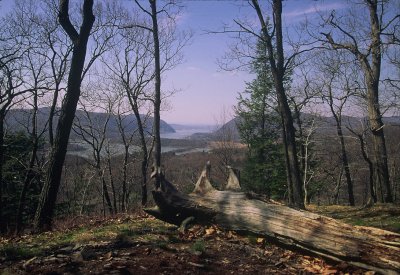
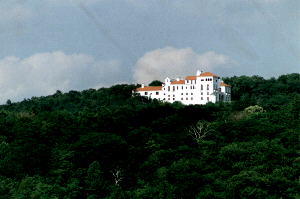
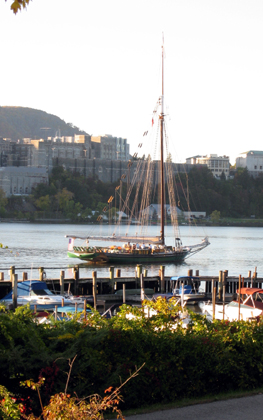
By the end of the summer of 1962 newlywed Kirt and Mary had moved to the tiny rural Hudson River town of Garrison, New York about 50 miles north of New York City in the scenic Hudson Highlands and directly across the Hudson River from the U.S. Military Academy at West Point. I have no recollection as to why they chose Garrison but it turned out to be a worthwhile and interesting place to live. Garrison was (and apparently still is) more of a geographic area on a map than a "town" as such as it had no downtown or shopping area to speak of. The only place that could even remotely be considered a town center or gathering spot was a small area directly on the river where the small railroad station was located along with a few quaint old residences and a combination mom-and-pop country convenience store and pub named Guinan's where everyone in town came on Sunday mornings to pick up their reserved copy of the New York Times. The main road through town (Rt. 9D) didn't even pass through this river front area known as Garrison's Landing. Residents of Garrison tended to live inconspicuously off in the woods and consisted of an interesting and eclectic mix of social classes from the local working folks, to executives who commuted daily via train to Manhattan, to the independently wealthy. The community was home to at least two "robber-baron" era castles in the hills above the Hudson. It was a friendly place to live and, regardless of social class, residents were united in their sense of pride in their rural lifestyle and the history of the area. In 2005 Gwendolyn Bounds, a Garrison resident, wrote a book titled "Little Chapel On The River - a pub, a town, and the search for what matters most" which focuses on Guinan's store and pub as a means of telling the larger story of Garrison and it's residents. Much in the book goes back to the 1960's when Kirt and Mary lived in and contributed to the community.
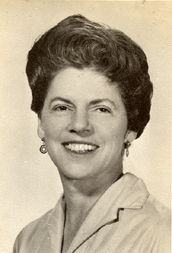
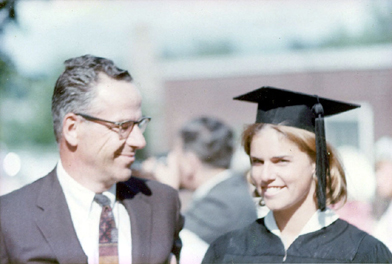
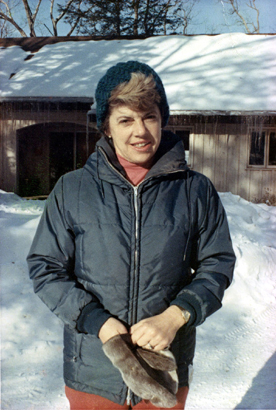
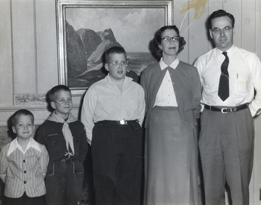
Mary, who in the 1930's had earned both BA from Wells College and a Law degree from Newark University and was 5 years older that Kirt, had 3 children from her previous marriage. Her eldest daughter, Margo Williamson, was by 1962 either married or close to it, Gail Williamson ("Abigail" in later years) was a college student, and Jerry Williamson ("Jeremiah" in later life), who was significantly younger, was still in grade school. With Kirt's two eldest sons (myself and Greg) away for most of the year at school and Henry living with former wife Betty, Kirt and Mary set up housekeeping with only Jerry living at home full time (and he would head off to private school in the mid 1960's). The rest of the combined family would visit frequently but mostly did not live with them. I did live with Kirt and Mary full time during the 1964/65 school year and commuted to school in Poughkeepsie, NY (and lived in Poughkeepsie the following school year). I also spent the summers of 1965, 1966, and 1968 in Garrison. During their Garrison years Kirt and Mary had a dog (cocker spaniel) named Dandy who I believe had been Mary's before the marriage.
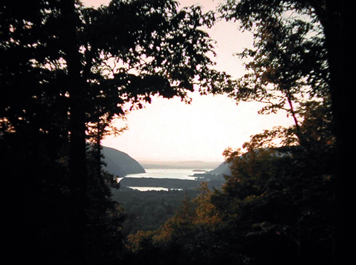
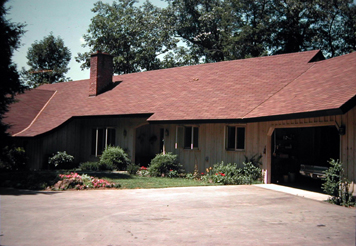
The Garrison Home Kirt and Mary rented a home on Avery Rd. (which they always referred to as the "Crum" house after it's owner) when they arrived in Garrison while they found land to purchase, had architect's plans drawn up, and had a house built. They moved into their newly completed home during the spring of 1964. It had 4 bedrooms and 3 baths and was on a hill overlooking the Hudson River. It had a view of West Point directly across the river and of Storm King Mountain, a Hudson Highlands landmark, to the north. Access to the home was via a 1/4 mile dirt/gravel road they had built up the hill from Cat Rock Rd. (Rt. 403) maybe 1-1/2 miles from Garrison's Landing. The home was in a remote location and as part of its construction Kirt and Mary had to pay to have power and phone lines run up the hill from the main road. Kirt liked to tell a little story about the home's water well. He was never a superstitious person nor did he believe in supernatural powers but apparently he had a friend who had a friend who claimed to be proficient at finding underground water using a "divining rod", a "Y" shaped wooden stick which when held in the hands of an appropriately trained person would point downward when it passed over underground water. Kirt, more to humor his friend then because he had any faith in the outcome, allowed the diviner to scan the property one afternoon. After walking around with his rod for and hour or two the diviner indicated a spot he said would yield far more water than any other on the property. Since it was conveniently located near where the architect had recommended the house be built, Kirt had no problem having the well drilled there. When the well was drilled water was found only several hundred feet below the surface (far shallower than expected) and the potential usable water flow was measured at over 30 gallons per minute, 10 times the amount that was needed by an average house. I don't know whether Kirt paid the diviner anything for his effort but if he did, it was well worth the price. The Garrison home was a great place to live and it's remoteness combined with the character and low crime rate of the community allowed for lax home security which today would seem totally unrealistic. The doors to the house were never locked day or night unless everyone was gone for an extended period on vacation. And the keys were never removed from anyone's automobile ignition when parked in the driveway in case a car needed to be moved.
Work Life
When Kirt first moved to Garrison he needed
some space for the E. K. Hine Co. to work out of so he could continue
his entrepreneurial projects. He rented about 1100 square feet of
space in the
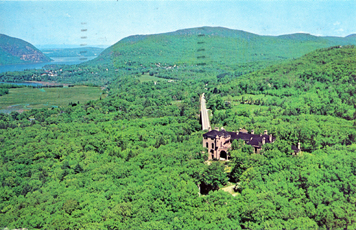
basement of an interesting local landmark named Dick's Castle (aka Dix
Castle) located
overlooking the river along Route 9D halfway from Garrison to the nearby town of Cold
Spring and only a few miles from home. The castle, on which
construction had halted in the early 1900's due to the financial
difficulties of it's builder, was little more than millions of dollars
worth of poured concrete structure which had never been finished. It
encompassed 35,000 square feet on 3 principal floors plus a 10,000
square foot basement. An interesting fellow named Anton Chmela (pronounced kuh-mella) had purchased the unfinished castle in the
1940's to use it's basement as a location for his manufacturing company
which made radio crystals for the government during World War II.
He had finished a small portion of an upstairs area for use as a home
for his family (where he lived till 1980). By the 1960's Anton was
no longer using the castle for manufacturing but was still living there
and it had become somewhat of a local attraction for tourists
driving by on Route 9D. An inexpensive homemade sign was
placed on the highway offering tours of the castle for 25 cents per
person. Anton's daughter Helen saved enough money from the
quarters she collected as a child giving tours of the unfinished ball
rooms, halls, and expansive porches to put herself through
college. Kirt's small rented space in the basement had a 3 foot thick
external concrete wall (which kept it warm in the winter and cool in the summer)
and was adjacent to the old manufacturing machine shop which was, while
unused, still functional and contained perhaps 50 workable heavy duty
machine tools of various types (laths, milling machines, drill presses,
etc.). This abandoned machine shop was a tinkerer's dream and thus an ideal place for Kirt's office
and laboratory.
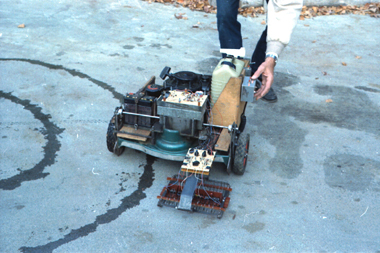
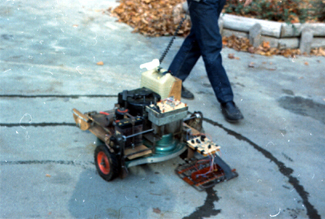
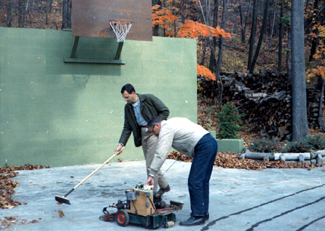
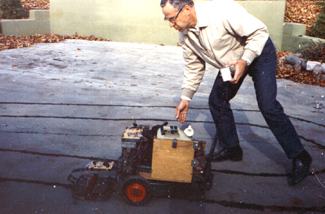
The "Model 101" Project "Model 101", as Kirt called it, was his effort to design and develop a self-guided lawn mower, that is, one that would mow the grass without an operator having to guide it around the lawn. Kirt's background in electronics and servo control design was ideally suitable for the task and he spent the years between about 1962 and 1967 working on it pretty much on a full time basis with only the help of a part time machinist who was hired to make many of the mechanical parts in the Dick's Castle machine shop. The general design concept was to develop a machine that would follow a small but electronically detectable chemical trail around the lawn and have bumpers and other sensors which, along with some basic electronic intelligence, would redirect the mower if it bumped into anything or otherwise got into trouble. The operator would in theory guide the mower once around a desired full circle perimeter while the mower left behind a harmless liquid chemical on the grass which it could then follow. The mower would then automatically follow its own path in ever decreasing circles till it had mowed all the grass inside the starting perimeter. If it hit an obstacle it would back up a little, make a slight turn, and try again on a trial-and-error basis till the obstacle was circumvented. These were the days before affordable small computers (the only ones available cost millions of dollars and filled huge rooms at large corporations) so all the "intelligence" had to be designed using discrete electronics on circuit boards with individual components such as transistors and resistors soldered together. Kirt would design and build these in his Dick's Castle office/lab/machine shop.
By the summer of 1965 Kirt had most of the bugs worked out of the guidance system and he could be seen often with his working prototype on the golf course at Garrison's Highlands Country Club performing tests. He proved that he could make the prototype reliably follow it's chemical trail in ever decreasing circles. But tests that summer also showed that he needed a much improved clutch and transmission mechanism to make the mower practical. The problem was that the commercially available clutches and transmissions he could readily purchase were not fast enough to adequately change the direction of mower movement when the electronics detected that a bumper had encounter an obstacle. The mower weighed a lot and almost instantaneous response was required to prevent damage to the mower and/or the obstacle. Kirt spent the next year developing his own clutch/transmission assembly in an attempt to solve this problem.
During the summer of 1966 he hired me while on vacation from college as a technician primarily to test his design. The clutch/transmission assembly was designed to take the output of the lawnmower engine (around 2 horsepower) and apply power to two drive wheels independently in three modes: forward, stop (no power applied and break on), and reverse. Each wheel had to be able to act independently of the other such that both could be running in forward mode or one could be going forward while the other ran in reverse or was stopped. And the full power transition from forward to reverse had to take place almost instantaneously. Kirt's design fit in a housing about 6 inches in each of it's 3 dimensions. (For those interested in a little more technical description: Power came into the assembly where it was split using standard gear technology onto 2 output drive shafts, one for each mower drive wheel. Each output shaft had flat finely machined pieces of spring wire wrapped around it in close proximity to the shaft, one each for forward, backward, and break. By pulling the end of a spring a very small distance with a tiny electronic solenoid the spring would grab the shaft and, like a Chinese finger puzzle, once engaged the power applied to the shaft would tend to make the spring wrap tighter around the shaft till the solenoid was disengaged. Electronics determined when each spring was engaged.) My job for 20 to 30 hours a week that summer was to run the prototype on a test stand in the lab (powered by an electric motor) for a period of time while circuit boards Kirt had designed independently changed the direction of each wheel shaft under varying loads from forward to backwards to stop about once a second. While the test was running I would take and log readings every few minutes from an oscilloscope he had set up with some other circuit boards to measure how fast the change of direction was taking (recorded in milliseconds). After every 10 or 12 hours of testing I would completely take the assembly apart down to it's smallest component and measure all the moving parts for wear with a micrometer. Occasionally a part would fail and Kirt would have to figure out what went wrong and design and build a more reliable replacement part. By the end of the summer I recall that the transmission/clutch was running pretty reliably and Kirt told me that, as near as he could tell, it was far and away the fastest reacting such item ever built for its power rating. I recall that it could change the direction of a 150 lb. lawn mower powered by a 2 horsepower engine in about 20 to 30 milliseconds (assuming that the wheels had perfect traction with the ground). I don't recall ever hearing why development of Model 101 was never completed. After the summer of 1966 I was in school in Colorado most of the time till the summer of 1968 and by then Kirt's priorities had changed possibly because he had run into an insurmountable technical problem or maybe because he had decided to fully retire (or perhaps a combination of both). As I write this some 40 odd years later a major lawnmower manufacturer has recently started selling a mower which does exactly what Kirt's Model 101 was designed to do and in more-or-less the same way. As near as I can tell, however, it isn't exactly setting the market on fire if for no other reason than it is quite expensive. Also, a small household vacuum clearer is now being marketed using similar bumper technology to that envisioned and developed by Kirt. Both the new mower and the vacuum cleaner rely on today's well advanced micro computer technology, something Kirt didn't have available in the 1960's. Miscellaneous Garrison
Activities
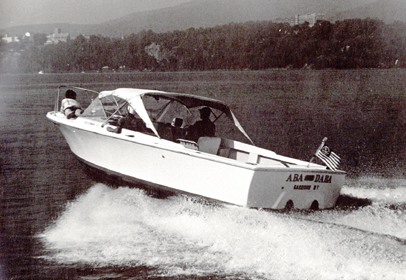
In the spring of 1963 Kirt purchased a Bertram 25 (25 feet long) fiberglass inboard motorboat which he named Aba-Daba and would have till 1967. He kept it at the tiny marina at Garrison's Landing and used it to explore the river. During his outings on the Hudson he learned first hand how polluted the river had become after over a hundred years of unregulated industrialization and ever larger river communities dumping raw sewage into it. He discouraged us kids from swimming or water skiing in the river for fear we would get sick or ingest chemicals which would cause long term health problems. I recall one day coming along when Kirt took the then President/CEO of Curtiss-Wright Corp. for a trip on the river in the Bertram. The CEO of Kirt's former employer had sought him out (I presume by word-of-mouth from other Curtiss engineers) to get his nautical advice on the feasibility of water-jet powered boats, a technology then being developed and explored by a number of companies. Curtiss-Wright was looking for growth opportunities and the CEO wanted Kirt's opinion as to whether the concept had merit. Curtiss never did enter that market but today water-jet driven craft are a reality but primarily in the personal watercraft market. Most larger boats still use propellers.
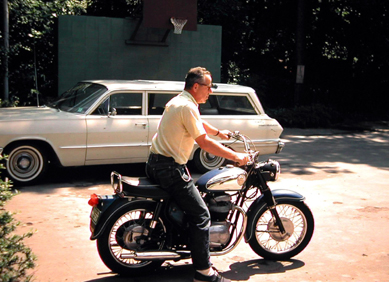
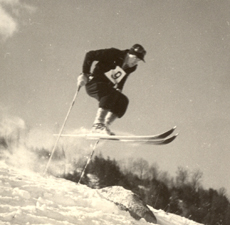
Kirt's skiing days were pretty much over after his marriage to Mary. With the exception of him taking myself and/or Greg on a few ski weekends from our New England private schools during the next couple of years I don't believe Kirt skied at all during the remainder of his life. The days of regular family ski trips were over. I suspect that this was primarily because Mary was not a skier. I do recall that Kirt helped a local Garrison kids group design and build a tiny ski rope tow in or near Garrison drawing on his Vernon Ski Tow experience. This was pretty much a one weekend project I think. And an event only indirectly related to skiing: In the 1930's Kirt had managed to become one of the top competitive skiers in the nation without ever having broken a bone (and those were the days before most ski equipment was designed with safety in mind). In 1965 Kirt was curiously trying out my skate board (a new invention at the time) on the absolutely flat Garrison house driveway. As he stood balancing on the board with it not moving in any direction it suddenly flipped out from under him and he broke his lower leg, a very embarrassing event. He was in a cast for 6 or 8 weeks and had to rent a car with an automatic transmission as his car at the time had a manual transmission thus requiring the use of both legs to drive. Shortly after moving to Garrison Kirt traded in his green Oldsmobile Starfire (which he and I had driven back from Nevada after he had received his divorce) for a powder blue Oldsmobile Jetfire, a smaller, sportier car even though it was not a convertible. A few years later he moved back to a convertible when he purchased a dark blue Chevrolet Chevelle Malibu. During these years Mary mostly drove a sporty little Chevrolet Corvair, a very popular rear-engine vehicle of the day but one that would develop a reputation of being unsafe. Kirt also had a blue Willy's Jeep, a 1960's version of the venerable World War II army utility vehicle. It's primary function was as a snow plow to clear the driveways of both the home and Dick's Castle in the winter. It could climb anything but would only go 50 miles per hour flat out going downhill on the highway.
During the Garrison years Kirt continued to be a heavy social drinker and smoker. Mary shared these habits though she would quite both "cold-turkey" later in the marriage. Each night when Kirt came home from work the mixed drinks would appear and wine was usually served with dinner. During the time I spent on-and-off in Garrison occasionally it was clear that Kirt and/or Mary had had to much to drink and they would at times yell at each other later in the evening when in this condition (though there was never any physical abuse). They frequently had guests over for dinner or had dinner elsewhere with friends. Mary was a good cook who liked to add a little wine to flavor almost everything she prepared. When I was commuting to Poughkeepsie from Garrison during the 1964/65 school year I was playing guitar in a Rock & Roll band and once a week on the same night we would practice in the Garrison living room. It became a tradition for Mary and Kirt to go out to a restaurant for dinner on band practice night so they didn't have to listen to "all that noise". It became Mary's favorite night of the week because she didn't have to cook. My recollection of what Kirt and Mary did for vacations during their Garrison years is somewhat vague. I believe they may have visited the Kennebago Lake Club in Maine once or twice early in their marriage and that Mary made the trip to Seattle with Kirt at least once to meet his mother and sister. Mary had a small vacation home in Wellfleet on Cape Cod, MA which they visited occasionally but not regularly or for extended periods. Mary and Kirt also took at least one winter cruise aboard a chartered sailboat in the Caribbean (which would be a harbinger of things to come). Volunteer Activities Hudson River Conservation Society Soon after moving to Garrison Kirt came to know a longtime resident who was affectionately referred to locally as General Osborn. This was Frederick Henry Osborn (who I believe had been a Major General during Word War II). General Osborn was one of several local descendents of perhaps Garrison's wealthiest and most famous deceased former resident, his grandfather having been William Henry Osborn, a very wealthy 19th century railroad tycoon. (One local Osborn descendent lived in Osborn Castle, another of Garrison's local landmarks.) Kirt came to know General Osborn well and he and Mary would frequently be invited to dine with the Osborn's. The General was a serious philanthropist and one of his favorite projects was doing something about the condition of the Hudson River which had become one of the most polluted bodies of water on the planet after several hundred years of being used as a dumping site for industrial waste and city sewage systems. The river was close to being "dead" and it supported just of fraction of the marine and biological life it once had. General Osborn was involved with an organization called the Hudson River Conservation Society, a volunteer, not-for-profit group, whose goal was the cleanup of the river and Kirt, having grown up sailing on the pristine unpolluted waters of the Pacific Northwest, had no problem identifying with and supporting this goal. Kirt would not have called himself an "environmentalist" as the term is used today (and the term wouldn't come into common usage till the 1970's) but he did agree that the Hudson was a mess and could and should be cleaned up. Before long Kirt was serving on the Board of Directors of the Hudson River Conservation Society (HRCS), I suspect after a little arm twisting by General Osborn. I never knew the details of his involvement but I do recall that the board met regularly, perhaps one or two times a month, and that Kirt also worked with other's frequently between board meetings including with Richard Ottinger, the then U.S. Congressman from the district, I presume regarding possible legislation. Kirt's involvement with the HRCS was for only a few years as he retired to Florida in 1969. By the late 1960's I'd permanently settled in Colorado and completely forgot about the Hudson till a couple of years ago when I happened upon a television documentary about the river by well known TV commentator Bill Moyers on my local Public Broadcasting System station. In it I learned that the effort to clean up the Hudson River, which had taken almost 40 years, had been hugely successful and that the river was again alive with aquatic life. Apparently this effort is now widely viewed as the most successful grass roots environmental cleanup movement in history and is considered a model for other such efforts. Kirt was involved in the early days of this movement and, while his efforts were short lived, I'm sure he would be proud to have played an early small role in such a successful undertaking. In doing research for this biography I've learned that sometime over the intervening years the Hudson River Conservation Society was absorbed into what is known today as Scenic Hudson, the primary not-for-profit organization behind the effort to continue and maintain the cleanup. One of the current members of the Board of Directors of Scenic Hudson is Frederick Osborn III, the grandson of General Osborn, who now lives in his grandfather's former Garrison home. The Clearwater
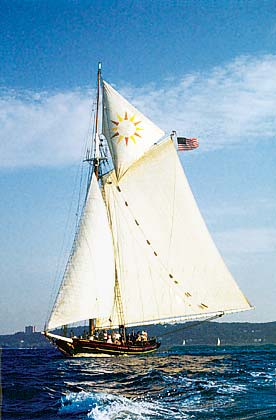
Kirt also played a very small part in a closely
related effort. In about 1966 Pete Seeger, a quite
famous folk singer and song writer of the 1950's and 1960's and resident
of a nearby Hudson River town, was researching the idea of
putting together an organization to build a replica of an 18th century Hudson River Sloop to once again
ply the river to being attention the plight of the Hudson. Pete
was apparently also involved with the Hudson River Conservation Society
and one day after a HRCS board meeting Kirt brought him home to the
Garrison house so Kirt could be filled in on the Sloop concept and comment
on it's nautical merits. Apparently Pete didn't know a lot about
boats or sailing but Kirt did. Kirt met at his home perhaps 3
or 4 times with Mr. Seeger regarding the idea and I have no idea what Kirt might have
recommended or contributed to the effort. (I had the honor of meeting
Mr. Seeger at the house one
afternoon while he was meeting with Kirt, a very exciting
thing for a young budding musician/guitarist.) Over my years in Colorado I became
vaguely aware that Pete Seeger's sloop had in fact been built and sailed
the Hudson but not till doing the research for this biography did I
learn
that the 106 foot "Clearwater" (as it is known) had been launched in 1969 and
today still successfully sails the
Hudson providing environmental education and advocacy. It is
apparently quite famous locally and has become a
significant
not-for-profit entity in and of itself. And it turns out that the
wife of Garrison's Frederick Osborn III is the
current (around 2012) President of Clearwater's not-for-profit sponsoring
organization.
Garrison Station Plaza / Garrison's Landing Association Around 1967 20th Century Fox, a large Hollywood movie production studio of the day, began planning to make a film version of the long running and very popular Broadway play "Hello Dolly". The film, which would star Barbara Streisand and Walter Matthau (both famous in their day), was to have a budget in excess of $20 million which would make it one of the most expensive movies ever made at the time.
The studio needed a set location to simulate Yonkers, NY and it's riverfront railroad station area as it was in the 1800's and Garrison's Landing was the perfect site. A group of local citizens, led I believe by General Osborn, saw an opportunity to make this a win-win situation for both the studio and the community. The Garrison riverfront, it's old railroad station, and the hand full of nearby buildings had become somewhat run down over the years and were in bad need of a major overhaul. The citizens group, which included Kirt, devised a business structure under which the over $1 million 20th Century Fox spent to revitalize Garrison Landing for the movie would be hopefully preserved for future generations. The details were negotiated with and agreed to by the studio which shot the Garrison portion of the movie during the summer of 1968 and employed a lot of local contractors and dumped a lot of money into the local economy. Two closely related organizations were formed to provide for the long term preservation of Garrison's Landing. Garrison Station Plaza, Inc was created to own, lease, and maintain the Landing's buildings and Garrison's Landing Association was formed as a not-for-profit organization charged with maintaining and preserving the marina, common spaces, and the old railroad station. The association owned some, but not all, the stock in the real estate company. I don't know exactly what roll Kirt played in all this but for a time he was apparently President of both Garrison Station Plaza and Garrison's Landing Association. I spent the summer of 1968 in Garrison and it was an exciting time. The rumor mill was always full of what was going on at the riverfront set at any point in time. While Kirt was not directly involved with any aspects of the filming, his involvement in helping to organize the town's participation allowed him access to the closed riverfront set which was not open to the public. He took me along a couple of times and once I was in a group of people informally introduced to lead actress (and famous singer) Barbara Streisand. Kirt and Mary had offered to rent their home to Ms. Streisand during the filming but, after touring the house the previous spring, she had not accepted the offer apparently since the house didn't have maid quarters. Hello Dolly was released in 1969 or 1970 and I saw it in Colorado. It didn't do particularly well at the box office and was therefore somewhat of a disappointment for 20th Century Fox. When Kirt passed away he still had some stock in Garrison Station Plaza and as I write this I still own some of his shares that passed to me. My recent research indicates that Garrison's Landing is still around and being well cared for as envisioned when the two related organizations were setup back in 1968. Finally, Kirt was a founding member of the Garrison Volunteer Ambulance Corp. which was set up to provided better ambulance service for rural Garrison. Yacht Marigo and Kirt's Retirement Years Kirt's mother Rose passed away in Seattle in April of 1967 at the age of 92. His share of her estate provided enough financial security that Kirt felt comfortable "investing" in a live-aboard sailboat. I recall being somewhat surprised when I heard he had purchased a larger sailboat as he had never expressed such a desire that I remembered. However, looking back now at his lifelong sailing background I guess it could have been predicted. And when Kirt, who never had much interest in reading or collecting books, passed away in 1977 one of the very few non-technical books found among his possessions was an old copy of "Westward Bound In The Schooner Yankee" written by Captain and Mrs. Irving Johnson and published in 1936. Irving Johnson was a very famous sailor in the first part of the 1900's and had sailed around the world multiple times and written extensively about his adventures in far away and exotic places. In the mid 1960's the National Geographic Society produced a 1 hour movie and TV special about one of his last circumnavigations. I suspect that Kirt may have read and kept this book from his college days and that it may have had a strong influence on his retirement years. Whatever the motivation, sailing to far away exotic ports-of-call would become Kirt's full-time passion for the rest of his life.
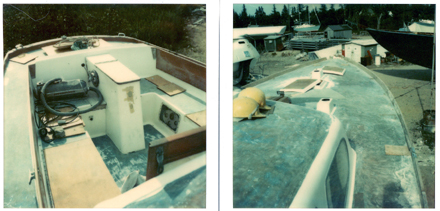
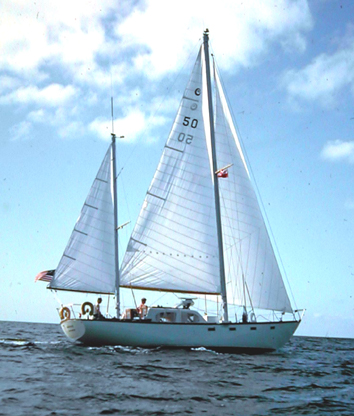
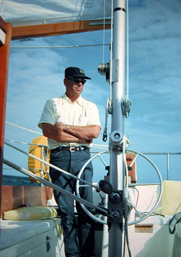
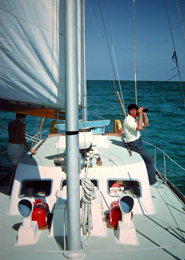
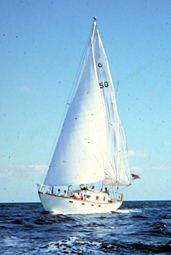
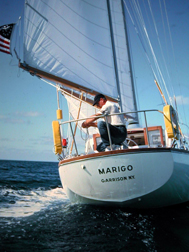
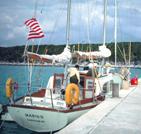
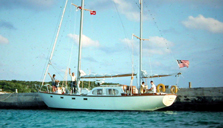
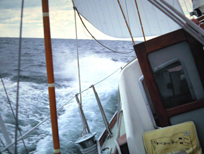
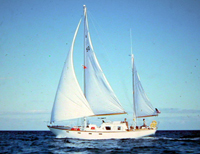
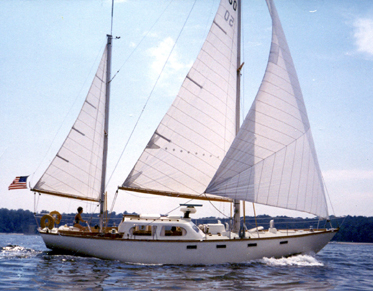
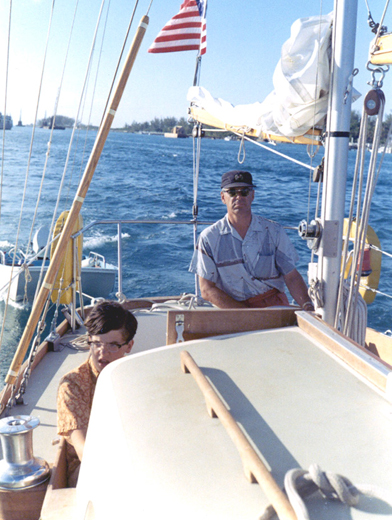
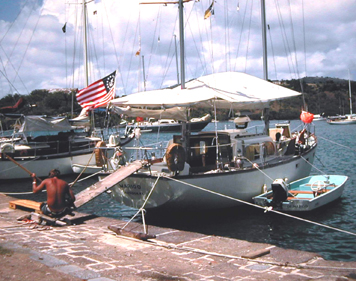
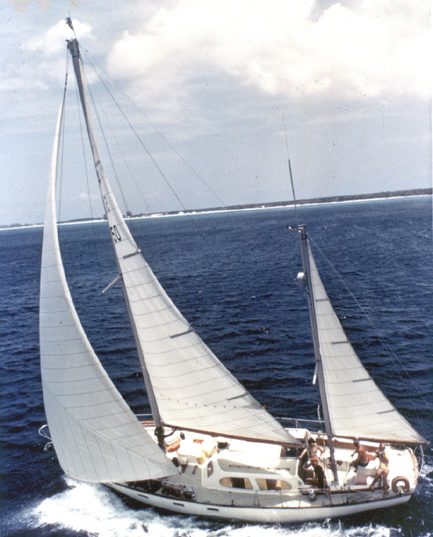
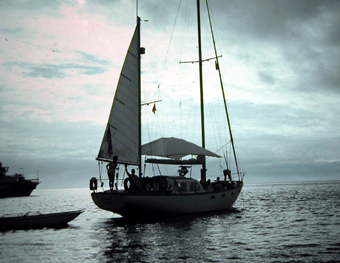
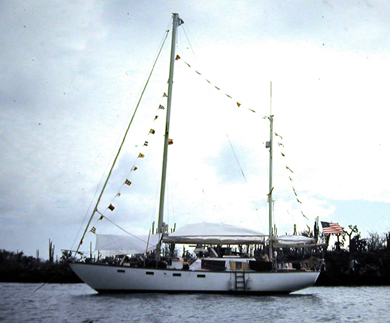
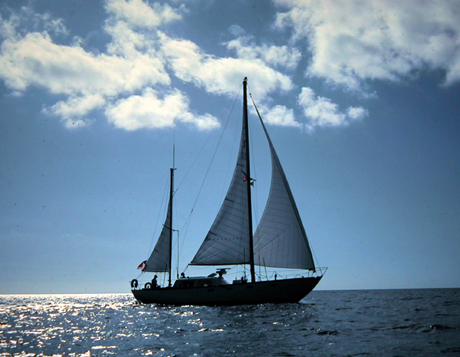
In early August of 1967 Kirt placed an order for a Pearson Countess 44 which he would name "Marigo" after a rough combination of his wife's name (Mary) and a favorite harbor in the Caribbean (Marigot Harbor, Dominica). "She" (Kirt was of a generation that always referred to boats and airplanes as being of the female gender) had a length overall of 44 feet, the beam was 12.5 feet, she was rigged as a ketch, and had a depth at the keel of about 6 feet. The Pearson Countess, a John G. Alden & Co. design, was the first production fiberglass sailboat of that length and Marigo was hull number 50 of a total of 59 built.
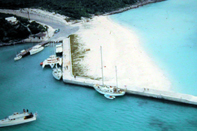
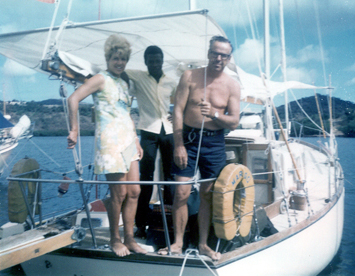
I visited Garrison for a week or so in the late summer of 1967 and Kirt took me to Bristol, Rhode Island to see Marigo being built. By early October Marigo had been taken to the Kretzer Boat Works at City Island, NY (near New York City) to be fitted out with equipment not provided by Pearson. Then Kirt took Marigo up the Hudson to Garrison where she was moored at the tiny marina while she was provisioned for her planned trip south for the winter. In November Kirt and Mary locked up the Garrison house and headed south via the Intercoastal Waterway which runs along the east coast to Florida. By Christmas 1967 Margio was south of Nassau at tiny Highborne Cay in the Bahamas where all Kirt's sons came for the holidays. We flew via commercial airline as far as Nassau where Kirt had arranged for a sea plane (a Grumman Goose) to take us from there to remote Highborne Cay. Mary's son Jerry was also there and we had a wonderful vacation and experienced first hand the life that Kirt and Mary would live for the better part of the the next 9 years. After the first of the year (1968) they sailed south as far as St. Thomas in the Virgin Islands before heading back north. For spring break in 1968 I, along with some college friends from Colorado, met Marigo in Jupiter, Florida and sailed into the Bahamas for a week. At that time Kirt and Mary were doing some preliminary looking into purchasing a home in Florida while on their return trip north to Garrison.
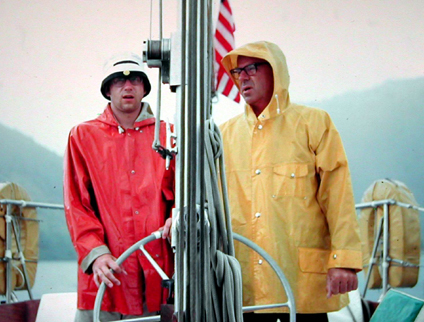
Kirt and Mary arrived back in Garrison in the spring after their extremely successful and fun winter cruise. Marigo would spend most of the summer of 1968 at Kretzer Boat Works at City Island near New Your City being re-fitted to Kirt's exact specifications now that he had a season's cruise under his belt and had a better idea of exactly how he wanted everything configured. Kirt devoted his time that summer to Marigo and his volunteer activities (this was the summer of Hello Dolly in Garrison). While his office at Dick's Castle was still intact he rarely visited it anymore and Project 101 (the lawnmower) had been substantially abandoned. My brother Greg and I spend that summer in Garrison and, along with Kirt, would drive to City Island 4 or 5 days a week to work on Marigo. In August Kirt and Mary took us and a few friends sailing for a couple of weeks. We first visited family friends on Martha's Vineyard and anchored in Menemsha Harbor. Next we sailed to Cape Code where we visited more friends and anchored off their summer home at Stage Harbor in Chatham. Kirt sometimes had a sense of the dramatic and always enjoyed having a little adventurous fun. During the sail across Nantucket Sound from Martha's Vineyard to Cape Cod he pulled me privately aside early in the day and said he wanted to perform a realistic man-overboard drill. He suggested that I dream up a way to stage something to surprise everyone and said that even he didn't want to know exactly when or how it would happen. Mid afternoon on that perfectly gorgeous sailing day and out of sight of land in the middle of Nantucket Sound I suddenly cut the dinghy loose (which was tethered behind Marigo on a line), yelled loudly "man overboard" and jumped in the water. Captain Hine and the "crew" had a great time responding to the staged emergency and in due time performed the necessary maneuvers to rescue me as I floated patiently in the dinghy. From Cape Cod we proceeded farther north to Marblehead Harbor, MA where Captain Hine took great pleasure barking orders to us crew members as Marigo tacked her way under sail through the numerous moored boats in the crowded harbor without the benefit of the auxiliary engine right up to the dock at the Corinthian Yacht Club, much to the amazement of numerous spectators.
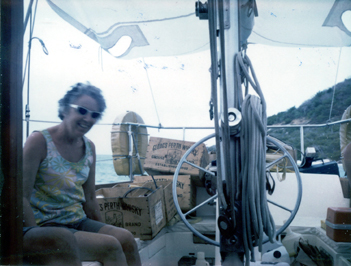
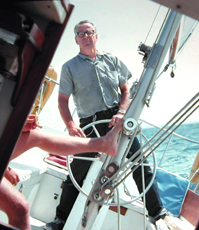
When Marigo was built Kirt had specified a finished interior suitable for long distance cruising and in theory she could sleep 7 aboard. There were 2 bunks in the "owners cabin" forward toward the bow which were always occupied by Kirt and Mary. 2 more bunks were located in the guest cabin amidships on the port side. There was a pull out "full" size bed which could be set up after removing the dinning table from the main salon/galley which would sleep 2. Finally there was a single small bunk (more like a cot) in the forepeak in the bow forward of the owners cabin. Marigo had one full, if cramped, head (bathroom) with toilet, sink, and shower and there was a toilet and tiny sink in the forepeak. Realistically, 2 guests along with Kirt and Mary made a comfortable ships complement as the pull out bunk in the main salon/galley area was awkward to use. The very cramped facilities in the forepeak (bunk and toilet), which shared the compartment with anchor chains, extra sails, and various lines, and was accessible only from a hatch on the foredeck, was generally only suitable for the occasional young and adventurous crewman whom Kirt would sometimes hire. Kirt, being an engineer and tinkerer by nature, loaded up Marigo with all the high tech nautical equipment he could find and/or fit aboard. In addition to all the basic things you would expect to find on most sailboats Marigo was fitted out with all the extras.
Marigo came equipped with a good auxiliary diesel engine, located under the cockpit, which could move her along at around 7 or 8 knots when not under sail. This engine had a generator for charging the ship's batteries but as a backup (and as a fuel saver for charging batteries in remote harbors without having to run the main engine) Kirt had an Onan brand auxiliary diesel generator installed. Marigo had 2 complete electrical systems, the standard nautical 12 volt system and a specially added 110 volt system so shore based appliances could be operated. The 110 volt system only worked when a generator was running or when Marigo was tied up dockside in a location which could provide shore power (which could also charge the ships batteries). As I recall, Kirt would need to run one of the diesel generators about 3 or 4 hours a day to keep the batteries adequately charged to run all the electrical equipment on board. Marigo had a complex custom electrical control panel which needed to be fiddled with as the type of power being used changed and depending on which battery charger was being used. I think that Kirt was the only person in the world who knew how to use it. Marigo had been built with extra large fuel (diesel) and fresh water tanks to facilitate longer stays in far away places. There was even a 110 volt hot water heater aboard but it was mostly used only when Marigo had shore power and fresh water available.
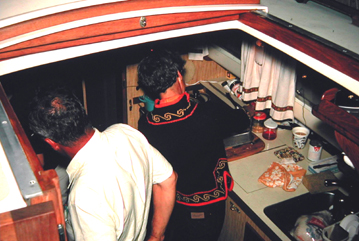
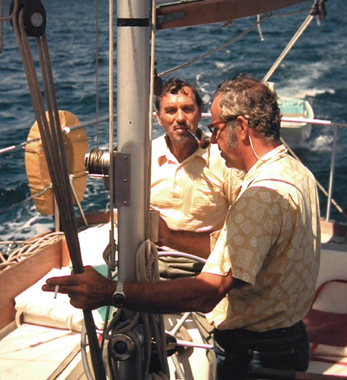
The galley was equipped with a several burner alcohol stove as well as some electric stove elements, a small sink with hot and cold fresh water taps, and a refrigerator. Marigo also had a deep freezer which Kirt had specially built into a sail locker in the cockpit. The freezer's long storage capacities allowed Mary come up with some amazing gourmet meals in very out of the way anchorages. Kirt had radar aboard with which he could "see" about 20 miles in bad weather or in the dark. For navigation (this was decades before the advent of GPS and computer navigation technology) he had a state-of-the-art Loran receiver which could determine a line of position based on signal delay from a shore based transmitter operated by the U.S. government (the same navigation system used by the U.S. Navy in those days). By plotting lines of positions from two transmitters you could determine your exact position (within a mile or two). The Loran receiver required some training to use and tune properly and only worked if you were within range of the U.S. based transmitters which became a problem the farther south into the Caribbean you went. When out of site of land and out of Loran range on long passages Kirt would determine position using the old and tedious celestial navigation techniques of taking sun or star sites with a sextant and then mathematically reducing the information into a line of position which was plotted on a chart. This required a chronometer (a highly accurate clock) and Kirt relied on his expensive and regularly calibrated Rolex wrist watch to provide accurate time. Marigo also had a depth sounder which Kirt regularly used to measure water depth as he maneuvered in and out of shallow harbors.
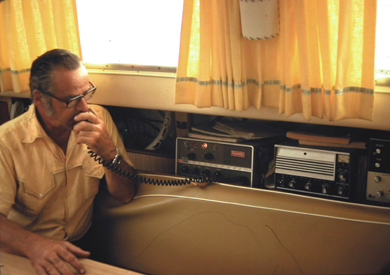
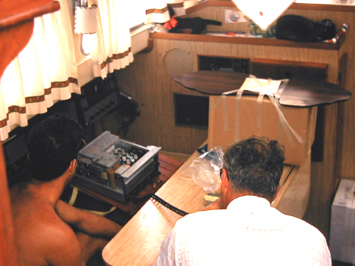
For communications Kirt had a number of two-way radios on board. He had the standard ship-to-ship and ship-to-shore radios. Probably Kirt's favorite toy on board was his "Hi-Seas" radio which allowed communication with the U.S. mainland from sometimes thousands of miles out at sea if the atmospheric conditions were right. This service was used mostly by cruise ships and ocean liners in those days and few boats Marigo's size had them. The land based station which covered the Caribbean in those days was in Miami and known by the call sign WOM. WOM could connect you with land-line telephone service and Kirt could therefore call friends and family from almost anywhere he sailed though it was a little awkward to do so by today's standards. You shared radio frequencies so there was no privacy as anyone else with a similar radio could listen in. You had to politely and patiently wait for the current call on the frequency to end and then make a transmission to the "Hi-Seas operator" and fight for their attention with all the others sometimes trying to get through at the same time. Often, if there were a number others trying to make a call, the operator would tell you that you were (for example) the 4th caller in line and you'd have to wait for the other 3 to make their calls. Once it was your turn you told the operator the telephone number you wanted to call and they would dial it and make contact with the party you wanted to talk to before you could talk. The conversation had to be one way at a time so each party needed to say "over" when a thought was completed so Kirt could press and release the transmitter microphone button as appropriate. These were expensive calls which were billed to Kirt's home phone and paid monthly by Kirt's accountant. If someone wanted to contact Marigo from the mainland they could call WOM and leave a message for Yacht Marigo which Kirt would get the next time he called the operator to see if he had any "traffic" (messages). Using WOM to make phone calls and/or to check for traffic was a once or twice a day activity for Kirt and he could regularly be found sitting in the main salon at the radio talking or listening till a frequency became available. All these years later I can still here him attempting to make contact due to the many times I heard him repeat the following over and over: "Calling Miami Hi-Seas radio WOM, this is Yacht Marigo - Whisky X-ray 9479 calling WOM, over". (WX9479 was Kirt's call sign and I heard him use it so many times that I still remember it today.) Those on the receiving end of Hi-Seas phone calls would hear something like this when they answered the phone: "Hello, this is the Miami Hi-Seas operator with a call from Yacht Marigo for Ted Hine............... Ok, hold while I connect you... Yacht Marigo, I have your party on the line, go ahead, over." The ensuing conversation was usually held amidst much background static and often the signal would fade in and out. Kirt got to know the Hi-Seas operators quite well and vice versa and, if things weren't to busy or as they waited for a long distance phone connection to go through they would make small-talk ("Marigo, did you ever get that so-and-so fixed"..... the operator listened in on all calls so they could tell when they were over and/or to fix technical problems with the connection which were frequent.)
Other radios aboard included a Citizen Band base station and several portable CB radios (large by today's standards) which shore parties could carry to communicate back to Marigo if within line-of-site. Kirt had a long distance amateur radio on board which he used to communicate with other amateur radio operators. During this period Kirt had obtained a "novice" amateur radio license and was randomly assigned the call sign WN4SXY. He was always tickled that the abbreviation for "sexy" appeared in his amateur radio call letters. His "novice" license entitled him only to transmit via Morse Code (something he had first learned as a teenager in his Seattle attic in the early 1930's long before licenses were required). He never bothered to move on to more advanced amateur radio licenses which would have allowed him to transmit via voice signal as the licensing requirements only applied when you were in U.S. territory. As soon as you were more than 12 miles off the U.S. coast the licensing requirements no longer applied and he could legally transmit on voice frequencies using his onboard amateur radio. To the best of my knowledge he never used the amateur radio when in U.S. waters but frequently used it elsewhere. What with all the radios aboard, Marigo's masts were full of antennas of various sizes, shapes and lengths. For entertainment Marigo had an AM/FM/Short Wave radio and an 8-track tape player with speakers built into the main salon area. Other "luxuries" aboard included a fresh water maker (desalination unit) which was almost always broken, an air conditioner (never used without shore power), and an auto-pilot, nicknamed "Iron-Mike", which was a god-send on long passages. Once sails were trimmed and a course set, Iron-Mike could be engaged and would hold the course reasonably closely though you would still have to check the course every 10 or 15 minutes to make sure it hadn't slipped a little.
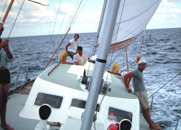
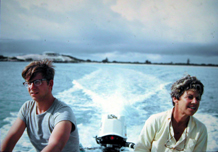
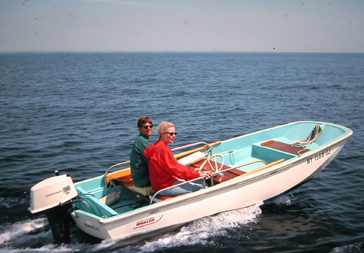
Marigo's standard sail configuration included a mainsail, a mizzen, and a roller furling jib which could be set and taken in from the cockpit. A mizzen-staysail could be set between the mainsail and mizzen if wind conditions permitted to gain another knot or so of speed. Marigo could carry a spinnaker but Kirt rarely had one on board figuring that one was little to complicated for cruising use. He always carried at least one spare for all sails. Kirt had an electric powered windlass installed to make bringing up either of the two anchors Marigo carried easier and had a custom canvas canopy made which could be set up to cover the cockpit area and provide cover from the sun when not under sail. For a dinghy Kirt chose a roughly 16 foot Boston Whaler, a popular and substantially unsinkable fiberglass and foam core boat of the day, on which he mounted a 25 to 30 horsepower outboard engine powerful enough to just barely water ski behind. The dinghy was named Go-Go and, since it was far to large to be stored aboard Marigo, was always towed behind her.
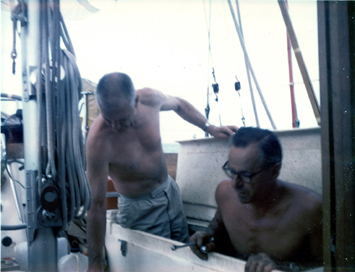
With all the mechanical and electrical "extras" Kirt had on board it wasn't surprising that something was always broken and needed repair. Salt air and water rapidly corrodes everything made of metal and the pounding of being at sea takes its toll. Almost every time Marigo was in port or anchored at some remote island Kirt could be found fixing something, often with his head stuck into or out of a hatch somewhere. He kept a good supply of spare parts and a well stocked took box on board. We kids used to joke that if everything keep working for more than a few days Kirt would get bored and go out and buy more equipment till stuff started regularly breaking again. And there was a certain truth to it. Kirt actually enjoyed fixing things and it was an integral part of the cursing experience for him. I don't think he would have had it any other way.
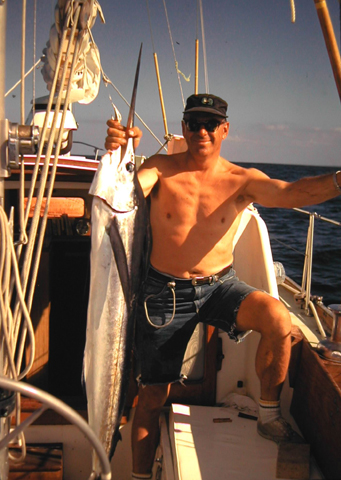
Marigo could be safely sailed anywhere with only Kirt and Mary aboard though they preferred to have additional "crew" (usually in the form of family and friends) particularly for longer ocean passages. Occasionally Kirt would hire someone to crew on long passages and more adventurous voyages. It was usually pretty easy to find an island youngster on short notice who would work for almost nothing plus food and an airline ticket back to the starting location in order to gain the experience. Such paid crew would live in the tiny forepeak. During the 9 years that Kirt and Mary spent cruising they had a steady stream of friends and family visiting aboard to help them make passage from one place to the next or simply to cruise around their current location. They were in effect operating a free charter boat in paradise with passengers only having to pay the cost of transportation to get there and food. For the 7 winter seasons they headed south for a number of months (1967/68 - 1973/74) they would pretty much have their guest schedule full before they left in the fall and then would fill in the voids and confirm "reservations" and travel schedules via Hi-Seas radio. Kirt would regularly call scheduled guests a week or two in advance and ask them to bring things which couldn't be obtained locally in some remote harbor. The "bring-list" could include everything from replacement parts for Marigo (often air-freighted to the guest before their departure) to a favorite brand of tooth paste not available locally.
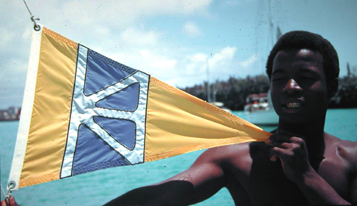
A typical season, which started in October or November and lasted till March or April, would find Marigo making her way south through the Bahamas, Virgin Islands, and West Indies as far as Grenada or Trinidad/Tobago near the coast of Venezuela before heading north again. Along the way Marigo would visit many famous and not-so famous ports-of-call for stays of anywhere from one night to a month. One year Marigo headed into the Gulf of Mexico and visited ports-of-call along the Mexican coast as far as Cancun and Cozumel. The 1970/71 trip through the Panama Canal and as far as the Galapagos Islands in the Pacific was the longest and most adventurous of her voyages. Mary and Kirt's favorite regular ports-of-call included the British Virgin Islands, St. Barts, Antigua, and Martinique. While not their favorite location, they would often spend as much as a month at St. Thomas in the U.S. Virgin Islands because the transportation for guests was good with great nearby cruising for them in the British Virgin Islands and it was a good place to provision and have needed work done on Marigo.
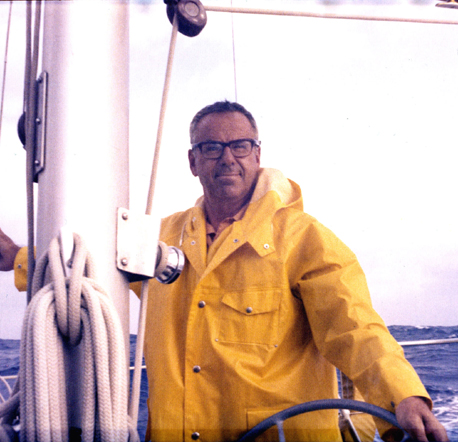
Kirt had a knack for quickly identifying and befriending local "movers and shakers" (his words) wherever Marigo went and he was thus able to quickly obtain "local knowledge" regarding passages, anchorages, weather patterns, and anything else a well informed yacht captain needed to know. In the early years he needed to learn this local knowledge but within a few years was spending more time providing it to others than learning it himself. Frequently Kirt and Mary would invite others they met, whether natives or captains, crew and guests from other boats, aboard in the evening for drinks and/or dinner and soon sea stories would be being told in the cockpit. Within a few years Kirt knew and had gained the respect of just about everyone worth knowing involved in sailboat cruising from Florida to Venezuela. While this covered a long distance and a large chunk of ocean, the cruising and charter boat community was a close knit group which relied on each other for everything from social contact, to advice, to local knowledge, and for help in an emergency. Kirt came to know many of the charter boat captains and owners of other private yachts and often Marigo would meet up with other sailboats and they would cruise together for anywhere from a day to several weeks. When Marigo made it to a larger port after some time in the out laying islands Kirt would go about fixing what ever had broken recently and taking on fuel and water while Mary worried about taking inventory of food-stores and making re-provisioning trips into the local town or village. Kirt continued his drinking and smoking habits though sometime during this period Mary quite both, something I give her a lot of credit for as Kirt's continued use of alcohol and tobacco made it that much harder for her to quite. When the "sun went over the yardarm" each late afternoon Kirt would always mix a drink for himself and whoever happened to have been invited aboard to socialize that evening and by bed time Kirt had often had a little more alcohol then he perhaps needed. But to his credit, I don't recall him ever sailing or piloting the boat while "under the influence". He was able to control his intake of alcohol to times when some impairment was acceptable. To his credit, Kirt always made sure that he ran a safe ship and the welfare of the passengers was always his first concern.
I recall Kirt mentioning more than once that
someday he wanted to sail Marigo to his childhood home of Seattle and
again sail the waters of Puget Sound and cruise in the San Juan Islands.
Such at trip would have
required two years to complete as it would have required passing through
the Panama Canal in addition to the long trip up and back
down the Pacific Coast. Perhaps he would have achieved this goal
had he lived longer.
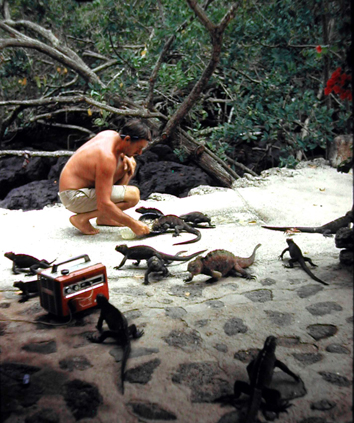
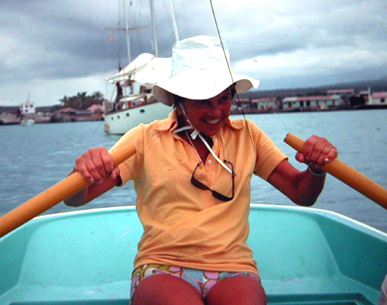
I visited Marigo in exotic places many times and thus gained a first hand knowledge of some of Kirt and Mary's adventures. Certainly the trip that stands out in my mind the most was their 1970/71 voyage to the fabled Galapagos Islands 600 miles off the west coast of Ecuador in the Pacific Ocean. Brother Greg and I visited Marigo there for two weeks in January of 1971. Today the islands are closely protected by the government of Ecuador and the tens of thousands of tourists a year that see the islands via numerous charter and cruise boats are monitored by government employees who are rightfully charged with the task of protecting the fragile environment. In 1971 there were no such government controls and very little tourism with only 1 small cruise ship containing maybe 50 guests making the trip from the mainland about once a month. Marigo was one of only about 3 private yachts in the entire island group during my trip and there were virtually no small charter boats around at the time. It was a very isolated place. Greg and I flew to Ecuador and took the one available flight each week out to Galapagos where Marigo met us at the World War II era air strip on the substantially uninhabited island of Baltra.
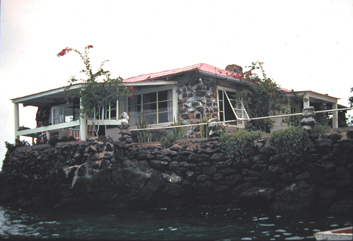
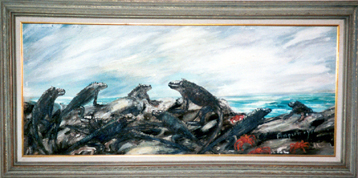
Kirt had already been in the Islands for a few weeks before we arrived and, as was his way, by the time we got there he had already made friends with some of the local colorful characters. Aboard Marigo for the day cruise to pick us up at Baltra was Karl Angermeyer, a German who had immigrated to the islands before World War II, and by 1971 was sort of "Mr. Galapagos". If you wanted to know anything about what was going on anywhere in the islands you talked to Karl. He lived in a home at water's edge on Academy Bay (on the Island of Santa Cruz and better known today as the town of Puerto Ayora) which had a population of perhaps 200 and was the second largest town in the Galapagos in those days. Academy Bay became Marigo's primary home port and re-provisioning spot while she was in the islands and when we were not exploring other islands she would be anchored just off Karl's home. Karl would come aboard for drinks and dinner occasionally and we all had lunch one day at his home (in and around which numerous iguanas wandered freely almost as pets). Among other things Karl was an artist and before leaving for home Kirt and Mary either purchased or were given a large oil painting by Karl which quite accurately captured the feel of the islands and it's volcanic starkness. For the trip to Florida the 48"x20" painting was screwed vertically onto the bulkhead behind the head (bathroom) door where it would be safe during the long voyage. The painting was then framed and hung in the Florida home living room. Today it hangs in my den. Before I left for the Galapagos Kirt had called via Hi-Seas radio with his "bring-list". In addition to the usual mundane items, the list included a pair of size 11 men's tennis shoes and a one-piece woman's bathing suit of a specific size. A little background: All during the fall of 1970 newspaper and television news was regularly covering an ongoing "territorial waters" tuna fishing dispute between the U.S. and Ecuador. Ecuador claimed it's territorial waters extended hundreds of miles from it's nearest land mass and the U.S. said Ecuador could only claim 12 miles. Every few weeks there were headlines that Ecuador had commandeered another U.S. tuna fishing boat for infringing on its territorial waters and the news media made it sound like the U.S. and Ecuador were close to going to war over the issue. I had been a little worried about heading to the Galapagos under these conditions but Kirt assured me that there was really no problem. It wasn't easy finding a one-piece woman's bathing suit and tennis shoes in Boulder, Colorado in January but I somehow managed. Shortly after I arrived in the Galapagos a fellow came aboard Marigo for drinks one afternoon and Kirt presented him with the tennis shoes and swim suit (for his wife who was not present). It turned out that this fellow was an Ecuadorian naval officer and the captain of the destroyer (a World War II surplus U.S. Navy vessel) which was regularly commandeering the U.S. tuna boats while on its routine patrols between Ecuador and the Galapagos. When Marigo had first arrived in the islands Kirt had needed some help fixing something and the destroyer captain had loaned Marigo his best mechanic for an afternoon. The specially ordered merchandise from the U.S. which I had had obtained and just delivered were thank-you presents. It turned out that what the U.S. news media viewed as a near war was nothing more than a little game being played between the two countries with Ecuador and the tuna fishing boats being the clear winners and the U.S. taxpayers being the losers. When a U.S. tuna boat was "commandeered" there was no resistance, in fact the tuna boats loved it. The boat was escorted to the port city of Guayaquil in Ecuador where their tuna catch was confiscated. The tuna boat crew then got shore leave while the U.S. government paid a steep fine to Ecuador and paid the tuna boat for a full catch, lost time, and expenses. When the fine had been paid the tuna boat would be released and would go right out and catch just enough tuna to get caught by the destroyer again. The financial incentive for the tuna fishing boats was to get caught and not to actually do to much fishing. Everyone was making money and having fun except U.S. taxpayers who were paying for it all. Before leaving the Galapagos for the long ocean crossing back to the Panama Canal, Marigo tied up to the destroyer and topped off her diesel tanks from the ships supply. The destroyer captain wouldn't accept payment for the several hundred gallons of fuel transferred to Marigo.
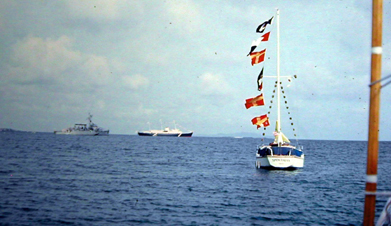
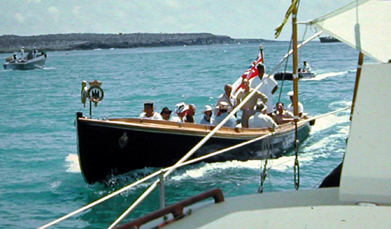
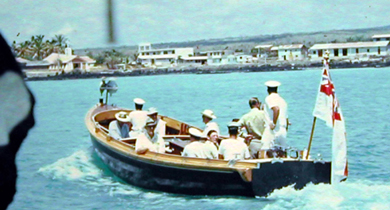
During my stay in the Galapagos word circulated that Prince Phillip of England (husband of England's reining Queen Elizabeth) would be visiting Academy Bay aboard the Royal Yacht Britannia to dedicate the newly established Darwin Research Station which had been set up so scientists could better study the huge Galapagos turtles and other wildlife. We made it a point to be back in Academy Bay the day before Britannia's scheduled arrival (as did the two other private yachts in the islands at that time) so we could get in on all the excitement at this tiny town of perhaps 200 residents. Britannia arrived on schedule along with a British Navy fuel and supply ship escort but since these ships had to much draft to get far into the harbor, they anchored perhaps 3/4 miles from the town dock. (The Britannia was the size of an ocean liner.) From our anchorage off of Karl Angermeyer's home we could see numerous tenders passing by about 1/4 mile away at their closest while making the straight line trip back and forth between the town dock and the Britannia as preparations were being made for the Prince's scheduled trip ashore the next morning. Kirt, never wanting to miss the opportunity to meet new and exciting people and having heard that the Prince enjoyed sailing, got out a sheet of Yacht Marigo stationary and handwrote a short note in which he invited Prince Phillip to, at his convenience, come aboard and "inspect" the American Yacht Marigo. ("Inspect" being Kirt's nautical short-hand for coming aboard, taking a look around, and perhaps having a drink.) The note was delivered to the Britannia in the dinghy by son Greg and Godfrey, Marigo's paid crew for the winter from the Caribbean island of Barbados. They were told to stand by in the dingy along side the Britannia and wait for a reply. In due time (maybe 20 minutes) they were handed an official British Royal Family envelope complete with the Royal wax seal. The response was promptly returned to Marigo where it was opened by Kirt and read aloud to all of us present. It was signed by the Prince's social secretary and indicated simply in very proper English that the Prince was to busy to accept the kind invitation but that the offer was appreciated. We were all a little disappointed but understood. Then, the next morning around the time Prince Phillip was scheduled to come ashore we noticed several tenders heading in our direction from the Britannia and thus not taking the most direct route to the town dock. With the aid of binoculars it was soon clear that this was the Prince's shore party flotilla which contained the "Royal Barge" along with several other small support and security boats. The Royal Barge didn't stop but as it passed within about 15 feet of Marigo the Prince greeted us by smiling and waving as we all cheerfully waved back. Prince Phillip may not have had the time to come aboard but he had found a way to personally acknowledge the invitation from the previous day. Shortly after lunch that day Kirt had a previously scheduled amateur radio contact to make and, since Marigo's amateur radio transmitter was broken, had made arrangements to use the one at the tiny hotel in town (which had maybe all of 4 guest bedrooms) and also happened to be where Prince Phillip and his party were having lunch and a dedication gathering. Kirt and I came ashore in the dinghy at the predetermined time and found that we had to pass through the main lounge in which the gathering was taking place to get to the radio room. The lounge was extremely crowded as maybe 30 Galapagos dignitaries and scientists along with the Royal party were in the room which was designed for more like 15. As father and I were negotiating our way through the crowd we literally and accidentally bumped into Prince Phillip. Someone mentioned that we were from the American yacht and the Prince immediately perked up and shook our hands. He also quickly introduced us to several other nearby members of the royal family. He was very cordial and commented in his deep British accent that he thought we had a very nice sailing craft. Our encounter with British Royalty lasted all of 45 seconds to a minute before we continued through the crowd toward the radio room. By the time Kirt's radio conversation was over the Royal gathering had broken up. Home Life During the Marigo Years
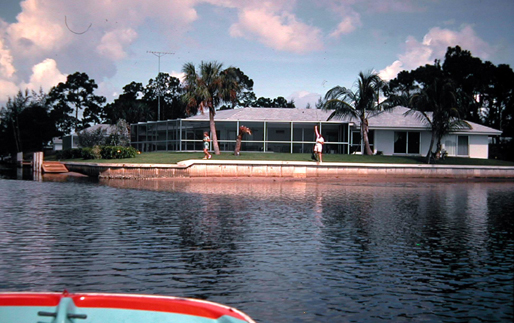
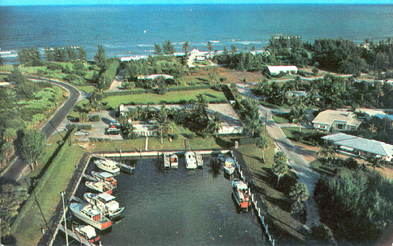
While on their way back to Garrison, NY in the spring of 1968 from their first winter cruise aboard Marigo Kirt and Mary had spent some time at the recommendation of friends in the Jupiter/Tequesta area of Florida (20 miles north of West Palm Beach) researching the possibility of permanently moving there. Taking Marigo annually from New York to Florida and back via the Intercostals Waterway was a long and tedious task which could be avoided by residing in Florida during the "off-season". Also, it was far easier and more financially rewarding to rent an otherwise unoccupied house in Florida during the winter months to help offset the cost of the winter cruise. The downside to moving to Florida was that they would be living there in the hot summer months. This apparently wasn't viewed as a major problem and by the time Kirt and Mary left Garrison in the fall of 1968 for their second winter cruise they had made the decision to make the move to Florida. They again stopped in Jupiter/Tequesta for several weeks as they passed through Florida on Marigo to purchase some land, fly the architect that had designed both Kirt and Mary's New Jersey homes and the Garrison house down to Florida for a few day's, and arrange for a building contractor. The new home was completed the following spring. It was located in an upscale development at 36 Tradewinds Circle, Tequesta, FL 33458 and had 3 bedrooms and 3 baths on one level along with a swimming pool. It was on a "corner lot" which meant that the home was bordered on two sides by waterways which connected to the ocean a couple of miles away. The waterways weren't deep enough to allow Marigo to get to the house so she was keep at the nearby Jib Club which was located on a deeper waterway closer to the ocean. Kirt found that he could commute to the Jib Club to work on Marigo quicker by traveling the one or two miles in the dinghy ("Go-Go") then he could by driving.
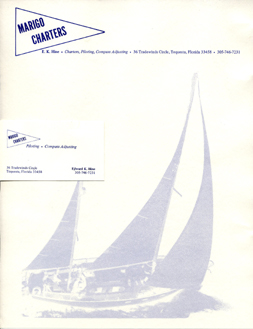
During the summer months Kirt would spend his time working on Marigo and getting her ready for the next winter's cruise. Marigo would usually spend about a month or so each summer in Spenser's Boat Yard in West Palm Beach having work done that Kirt couldn't do himself such as engine overhauls and bottom painting. He and Mary would usually fly north to New York and New England for a few weeks each summer to visit family and friends. The house was rented most winter season's after Marigo sailed south in the fall and till she returned in the spring and Kirt hired an accountant in West Palm Beach to handle his financial affairs while he was gone. This routine continued till 1974 when the long winter cruises apparently were becoming less attractive and Kirt and Mary changed there annual schedule. That summer and the following one (1975) they took Marigo north to cruise the waters of New England and only took much shorter winter cruses to the nearby Bahamas from the Florida home. During this period Kirt obtained a blue
Mercedes-Benz 240D automobile (diesel powered) which was purchased for him in Europe and brought
to the U.S. by one of Mary's daughters and her husband when they
vacationed there around 1975. (After Kirt's death son Greg would
drive this Mercedes till around 2002.) Also around this time Kirt was apparently arrested for driving under the influence of
alcohol and was required to take a safe driving course and had his
drivers license revoked for a month or so. Kirt raced Marigo in a
few Florida offshore sailboat races and offered Marigo for charter and made
himself available as a yacht captain and compass adjuster under the name
"Marigo Charters", ostensibly to bring in some extra money (which he
really didn't need). Marigo Charters never really amounted
to much and was operated more as a hobby to keep Kirt busy than as a
real business. I don't think Marigo was ever actually chartered
though I believe Kirt did in fact adjust a few compasses for other
yachts. Kirt maintained memberships in various volunteer and other
organizations around this time.
Starting in 1972 I was busy getting a business going in Colorado and no longer had the time to visit my father as frequently as I had in earlier years. Kirt visited myself and his other sons in Colorado around 1974 but other than this we kept in touch via an occasional letter or phone call and I wasn't involved in any of the details of his life. I suspect however that his drunk driving arrest was an indication that his life-long social drinking habit was getting worse and that he may have crossed the fine line and become a alcoholic.
By the spring or early summer of 1976 Kirt and Mary were separated and a divorce had been filed for. While I don't know the exact cause of their breakup, I suspect that Kirt's drinking was a significant contributing factor. Kirt sailed Marigo north to New York and New England without Mary for the summer of 1976. He had some work done on Marigo at the Hinckley Boar Yard in Southwest Harbor, Maine and Greg and I visited him there for a few days while we were in the North East on business. Kirt hadn't lost his knack for befriending the local movers & shakers. As we were having lunch in a restaurant overlooking the Southwest Harbor dock where Marigo was tied up a non-descript looking family with some young kids was seated at a table near us. Before sitting down the husband came over to our table and said "Hi Kirt, after lunch why don't you bring your kids down to my boat and I'll give everyone the tour". Kirt said sure and after his friend had seated himself with his family someone at our table asked Kirt who that was. Kirt said "Oh, that's so-and-so on vacation with his family. He's the CEO and Chairman of Xerox Corporation" (Xerox being one of the largest copier and technology corporations in the world in those days). Kirt had met him a few weeks before and they had come to know each other while both of their boats were being worked on at Hinckley. We in fact got the deluxe tour of his rather expensive Hinckley 50 foot sailboat after lunch.
That fall Kirt took Marigo back to Florida where he lived aboard her at the Old Port Cover Yacht Club and Marina in North Palm Beach since he and Mary were then separated. That fall Mary was in the process of selling the Tradewinds Circle home and purchasing a nearby townhouse so Kirt moved most of his shore-bound belongings into a West Palm Beach self-storage locker. December of 1976 would be an eventful month for Kirt. His divorce from Mary was finalized on December 3rd and shortly there after he would accidentally stumble aboard Marigo causing a minor break of a shoulder or arm bone. This however would not be the worst of his medical problems. In very late December Kirt, who had been for the most part quite healthy for his entire life, suddenly went to see a doctor suffering from jaundice. The problem was quickly diagnosed as a blockage of a bile duct and exploratory surgery was performed to determine the exact cause. The doctors found that the bile duct was blocked by a cancerous growth and Kirt was diagnosed as having cancer of the pancreas, a very serious and rapidly spreading form of the disease. The blockage to the bile duct was easily, if only temporarily, corrected during the exploratory surgery however Kirt's long term prognosis wasn't good and he was told he had only months to live. In early January 1977, only a short time after his diagnosis, Kirt volunteered to undergo an experimental operation in Miami at Jackson Memorial Hospital to see if the cancer could be successfully removed in its early stages. All three of his sons flew to Miami to be there for the operation. Unfortunately it was quickly determined during the surgery that the cancer was inoperable as it had already spread to far.
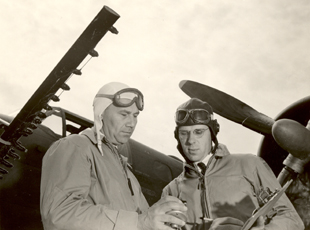
Mary, much to her credit, took her recently divorced former husband under her wings and Kirt moved back in with her at her new townhouse in Jupiter/Tequesta. She would actively care for him till his death. Kirt went about getting his affairs in order which mostly consisted of selling Marigo, something he could do much more effectively than could his estate at a later time. His medical condition deteriorated quickly as the cancer spread. By March he required full time hospitalization and was transported back Miami to the hospital where the January experimental operation had taken place and where the best care for his condition was available. Mary continued to care for him and slept on a cot in his hospital room. A day before his death Kirt, assisted by son Henry, signed the papers to finalize the sale of Marigo. Sons Greg and Henry were in Miami in a nearby motel when Kirt passed away at the age of 60 at 7:10am on April 2, 1977. Mary was at his side. I was scheduled to arrive the next day. According to Greg, Kirt's last thoughts as he was drifting in and out of consciousness the afternoon before his death were of his World War II days while working for Curtiss-Wright.
Final Resting Place
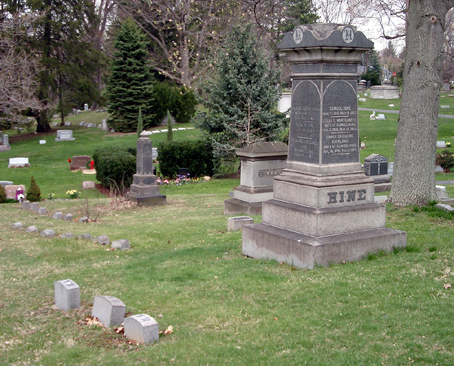
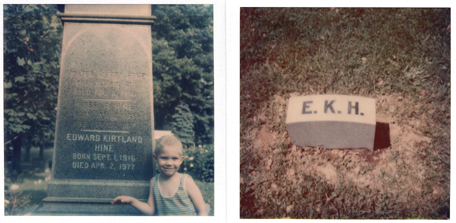
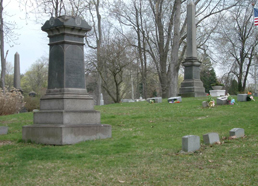
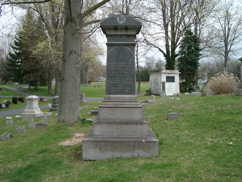
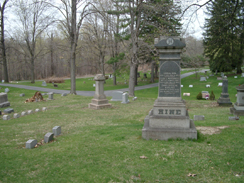
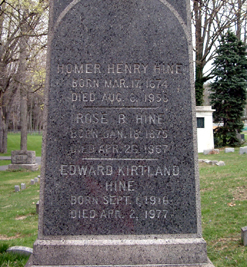
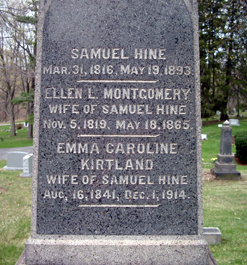
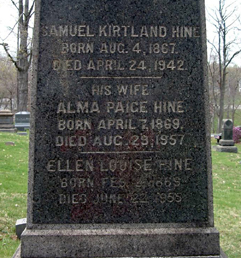
A small memorial service was held at a Presbyterian church in Tequesta, Florida on the afternoon of April 4th. The church was selected because it offered memorial services in a convenient location and not because Kirt was a member which I'm sure he wasn't. Those in attendance included all three of Kirt's sons, friends (mostly from the Florida area), and, interestingly enough, both of his former wives, Mary and Betty. Betty (my mother) flew in from her home in Hermann, Missouri where she had retired with her second husband. Kirt was cremated and a day or so after the memorial service myself, Henry, and Betty flew his ashes to Poland, Ohio were they were interred in the Hine family plot in the Riverside Cemetery with his parents Homer and Rose, grandparents Samuel and Emma Kirtland-Hine, his Uncle Kirt (Samuel Kirtland Hine), and his Aunt Nell (Ellen Louise Hine). Nearby are the graves of several generations of other Hine and Kirtland ancestors and relatives. Greg didn't make the trip to Ohio as he had volunteered to drive Kirt's Mercedes back to Colorado towing a trailer containing Kirt's remaining possessions. Greg would visit the grave site later that year. I've never fully understood why Betty accompanied her son's on the trip to Ohio. Perhaps it was to provide moral support to her sons or maybe because she felt a connection to her former husband's ancestors having represented Kirt at the funerals of his 3 uncles there in 1942.
Epilog
As per the terms of Kirt's will, I became the administrator of his estate which turned out to be a pretty simple and straight forward one to deal with. Having recently been divorced his legal and financial affaires were up to date and in order and the sale of Marigo a day before his death had taken care of Kirt's only significant physical asset. Mary had brought some financial assets to their marriage and she and Kirt had always meticulously kept their finances separate over the years. She had owned the homes in Garrison and Florida and Kirt had owned Marigo. This combined with the recent divorce significantly simplified the estate which pretty much amounted to paying estate taxes and distributing Kirt's stock portfolio and interest in the Cornelia W. Hall trust to his sons.
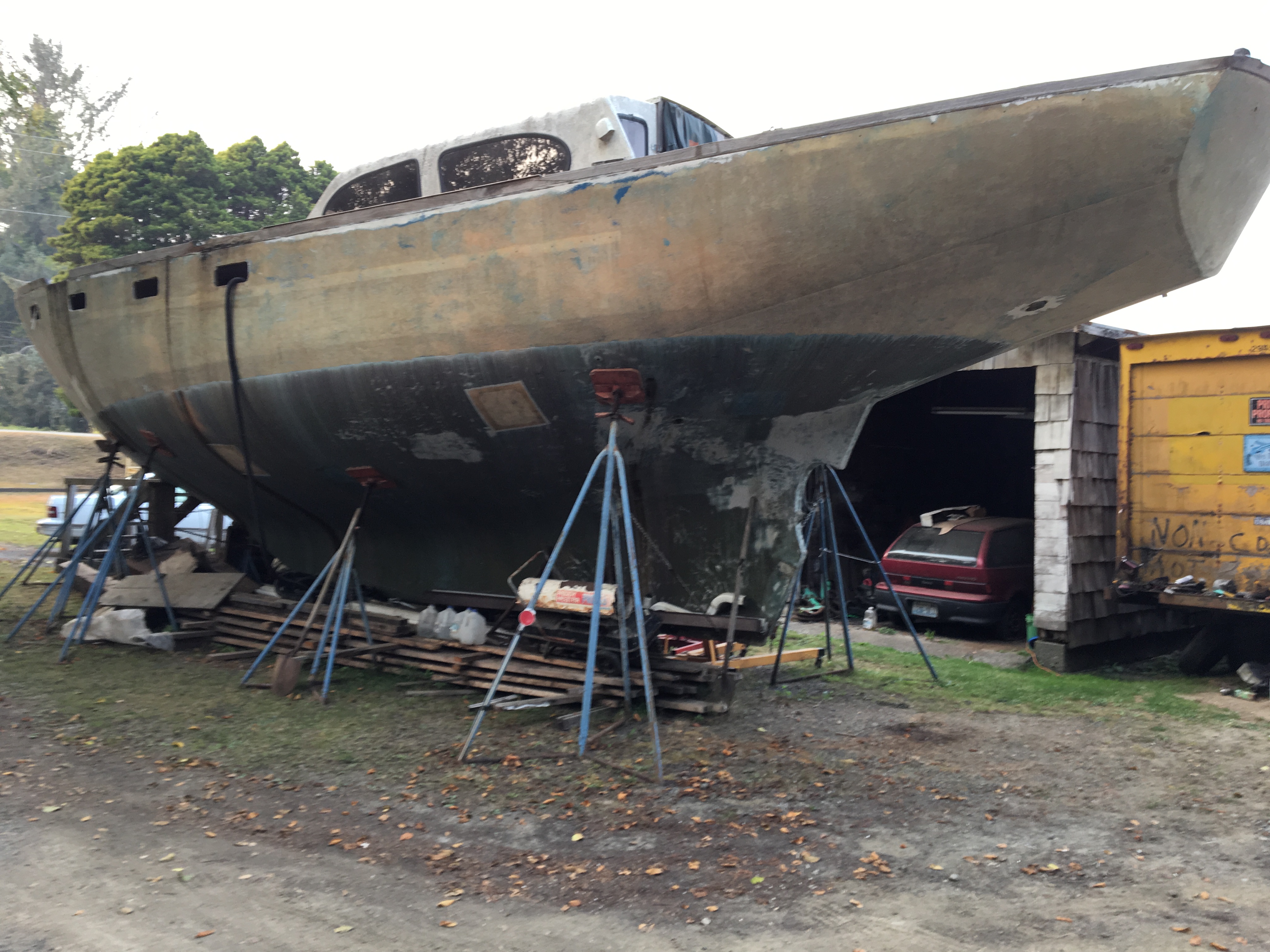
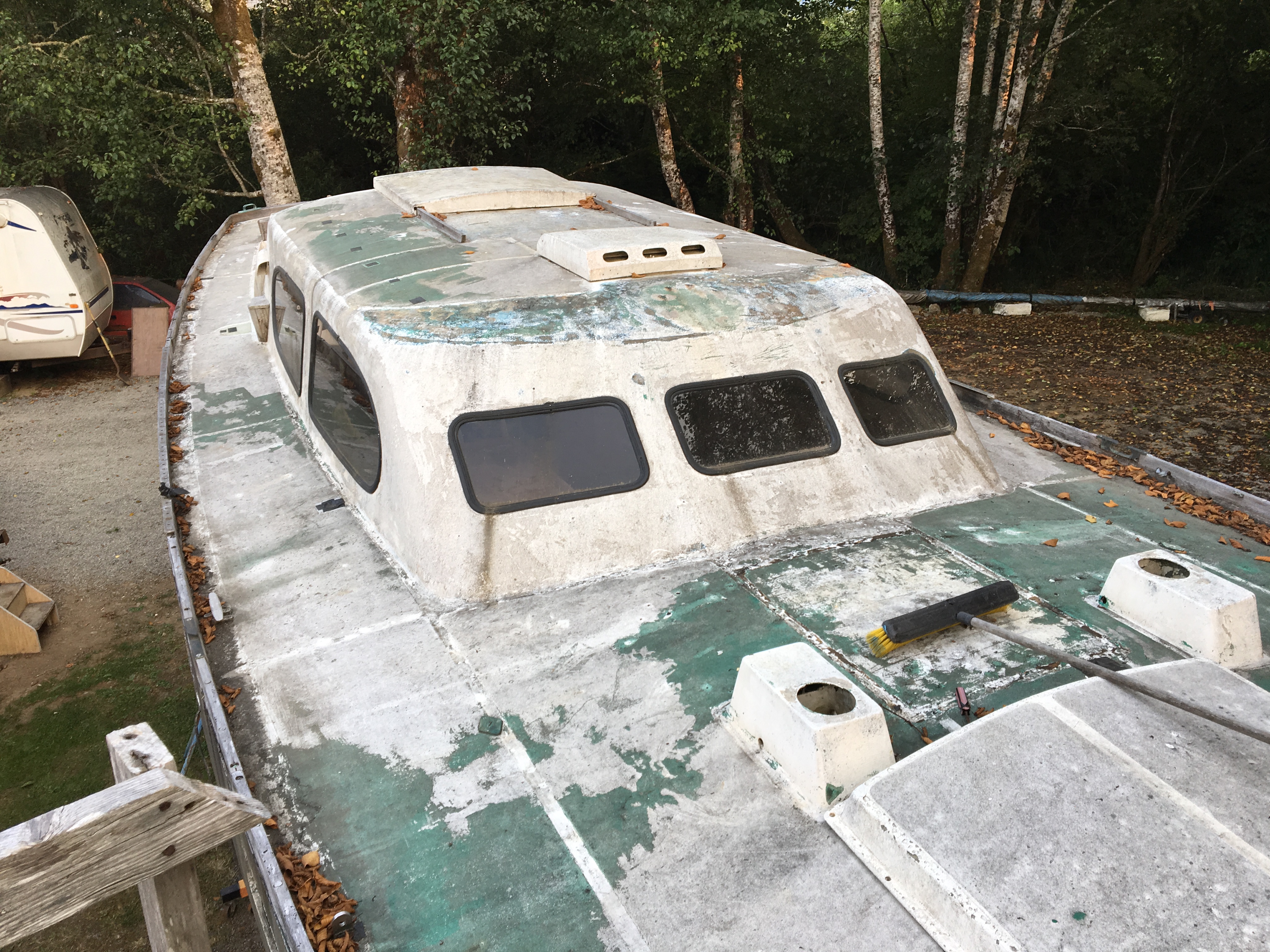
Kirt's first wife Betty would live happily in rural Missouri with her second husband till her death in 1996 at the age of 79. Second wife Mary would live in the same townhouse in Jupiter/Tequesta, FL till her death at age 93 in early 2005, 28 years after Kirt's death. Kirt's childhood sweetheart and lifelong friend Gina Bowden-Higman would spend the last years of her life near Seattle and pass away in 2007 at the age of 91. Kirt's sister Ruth Hine-Darling, passed away in 2012 just short of her 101st birthday in Leavenworth, WA. In the early 1980's, several years after Kirt's death, my brothers and I were in New York for a wedding and drove through Garrison for old times sake. No one was home at Kirt and Mary's former Garrison home but when we drove up to Dick's Castle we ran into longtime owner Anton Chmela who was in the process of cleaning out his longtime home pending the castle's sale. He took us into the basement where Kirt's 1960's office and lab had remained unoccupied since his move to Florida in 1969. Piled on the floor were boxes of stuff which Kirt had left behind many years before (and presumably asked Anton to dispose of) including all the prototype parts for his Model 101 lawnmower. When I next visited Garrison in 2008, Dick's Castle had been converted into high priced condominiums. Revisiting Yacht Marigo in 2018 The paperwork and payment for the sale of Marigo was officially completed in Florida the day before Kirt passed away in April of 1977. Over the decades since, little thought has been given by his sons as to what may have became of her. In the summer of 2017 one of my brothers discovered an obscure website dedicated to still existing Pearson Countess 44's and on it one was listed named Hannah-Marie with a footnote that said she had formally been named Marigo, which, not being a common name, caught his attention. The boat's location was shown to be in the tiny village of Clallam Bay, WA (population about 350) which is about a 3-1/2 hour drive north-west of Seattle on the coast of Washington's Olympic Peninsula and is thus very isolated and apparently not a tourist attraction. Upon learning this I attempted to contact the owner named Walter P. He didn't respond to an email sent to an address shown on the website so after several weeks I wrote him a letter at his indicated Clallam Bay post office box. He promptly responded by email indicating that he didn't have home internet access so had to visit a library to get and send email which he did only infrequently. He confirmed that Hannah Marie's former name had been Marigo and indicated that he'd owned her for about 16 years and would be happy to share information about her. I put together a 15 page summary of Marigo from my perspective and experiences during her first 10 years and emailed it to him. He responded with his thanks and said he'd get back to me and my brothers with more about his ownership when he had more time. To view my write-up for Walter
click here:
Walter never got around to getting back to us but a year later in the summer of 2018 my two brother's (Greg and Henry) were planning a trip to the Northwest to pick up a camper and so contacted Walter and made arrangements to visit. In late July they spent about an hour and a half with him and Marigo. Marigo is on "the hard" (dry land) in Walter's side yard in Clallam Bay where she's been since he acquired her around 17 years ago. She's in the company of numerous apparently dysfunctional cars, trailers, and other items. She is sadly in very, very poor condition and is nothing more than derelict hull. I wasn't there but my brothers report that Walter is in his later 70's, was very friendly and forthcoming, and interested in Marigo's early history. He had apparently purchased what was left of Marigo in "as is" condition for around $15,000 in Seattle around 2001 with the intention of restoring her in his retirement, something he obviously hasn't gotten around to doing. It was apparent to my brothers that Walter had spent considerable time researching the details of Person Countess 44 design and equipment as he had files full of information and documentation about this classic sailboat design. When he purchased Marigo she still had her name prominently displayed on the stern (transom) where Kirt had put it decades before but Walter had sanded it off intending to rename her Hannah-Marie. It was easy for Greg and Henry to tell that this was in fact Kirt's former pride and joy as everything was as they recalled it but with almost all fixtures and equipment missing. Walter knew little about Marigo prior to purchasing her and virtually nothing about how she came to be in the Pacific Northwest. He did have some documents showing several ownership changes in the Seattle area in the years just prior to his purchase (which brother Greg photographed - see photo section below). After the purchase there was apparently confusion and hassles getting a title for Marigo as the title had been, for unknown reasons, erroneously transferred at some point to someone else who didn’t exist in a perhaps shady transaction. He indicated that for unknown reasons she had sunk and had been underwater for an unknown period of time but long enough to make useless just about everything but the fiberglass hull. Wooden parts and structures had been submerged long enough to be infested with aquatic worms. The ownership documents suggest that Marigo had been in the northwest since at least 1995 and in 1998 a marina she was in obtained a chattel lien and sold Marigo at public auction to pay past due slip fees. Since almost any boat that floats is worth more than any reasonable period of slip fees, this suggest that Marigo may have been intentionally abandoned and thus perhaps sank from a period of total neglect and lack of maintenance. At one point Walter sold Marigo to someone else but soon bought her back. The photos taken by my brother Greg (more below) suggest that Walter, or perhaps someone prior to his ownership, had removed most of Marigo's damaged and dysfunctional fixtures and equipment, presumably to prepare her for restoration, so that pretty much all that's left is her fiberglass hull. Marigo's whereabouts and use from her sale in Florida in 1977 to her appearance in the Seattle area around 1995 and Walter's subsequent purchase in 2001 are unknown but available evidence suggests perhaps a possibly checkered existence. Brother Henry, who helped handle Marigo's sale the day before Kirt passed away, recalls that payment was strangely made to father using multiple cashiers checks drawn on a number of different banks in amounts less than the then legal amount required to be reported to the government by banks for large cash transactions. While a legal transaction from Kirt's perspective, this suggests that perhaps the purchase was made with "laundered" money and that Marigo could have been intended by the buyer for some illicit purpose. A little over 20 years later her possible abandonment at a marina in the Seattle area could be consistent with the common drug cartel tactic of simply abandoning a boat or aircraft after an illegal drug delivery. This is of course speculation and perhaps we'll never know for certain where Marigo was and what she did in the intervening years. Marigo's current condition is sad and depressing to those of us who knew her during her first decade from 1967 to 1977. For many years she was Kirt's pride and joy and provided much fun and adventure for him, Mary, relatives, and many friends. I note that it's interesting that Marigo did finally make it to Kirt's childhood home town, a trip he always wanted and intended to make with her but passed away before he could accomplish it. It can only be speculated as to whether Walter or someone else will eventually restore Marigo to her former glory. It would be a time consuming and expensive restoration but could theoretically be done assuming the hull is structurally sound.
|
||||||||||||||||||||||||||||||||||||||||||||||||||||||||||||||||||||||||||||||||||||||||||||||||||||||||||||||||||||||||||||||||||||||||||||||||||||||||||||||||||||||||||||||||||||||||||||||||||||||||||||||||||||||||||||||||||||||||||||||||||||||||||