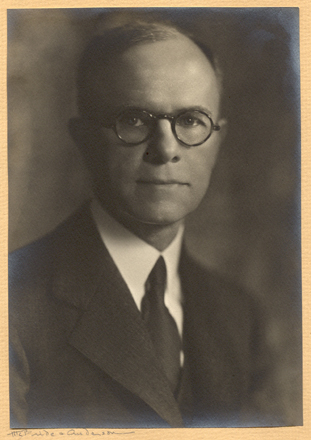
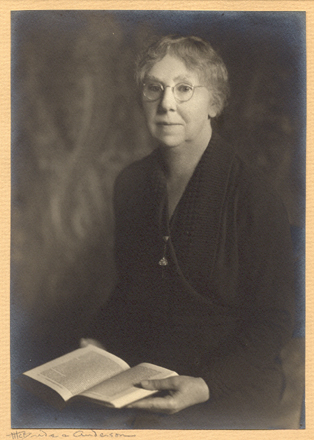
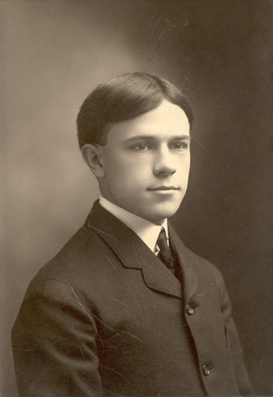
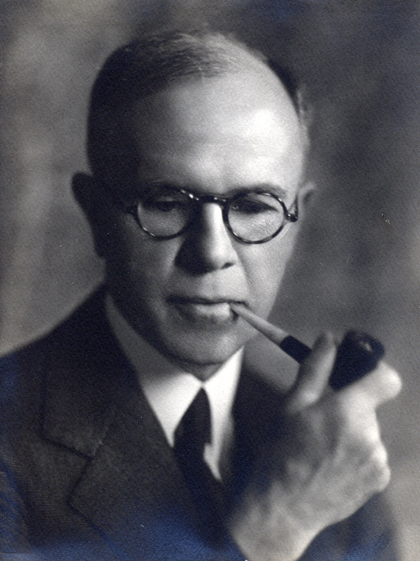
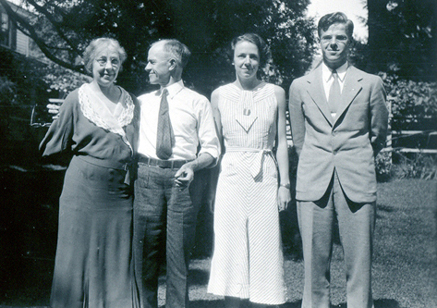
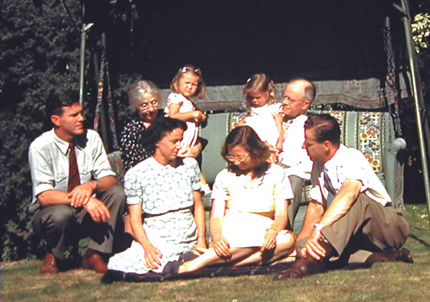
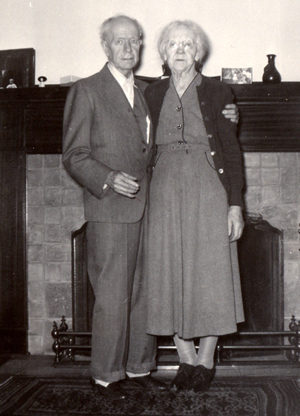
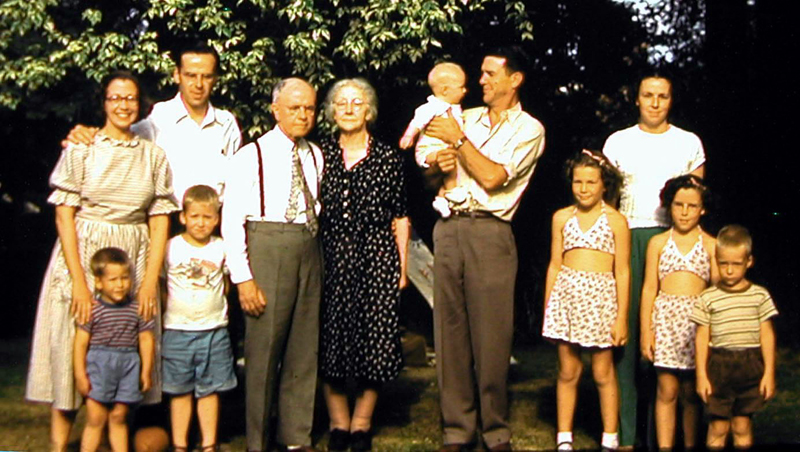
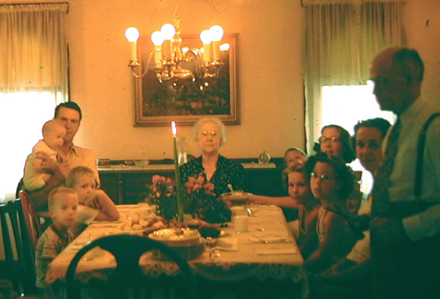
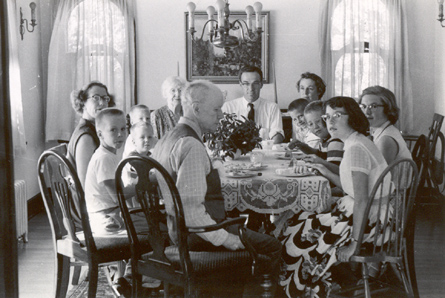
Homer Henry Hine
and
Rose Belle Turner-Hine
Introduction I didn't know my Hine grandparents very well due to our relative ages and physical distance. My father was born when Homer was 42 years old and Rose 41 and I was born when father was 29. Thus, by the time I was old enough to retain my first memories of my grandparents in 1950 (when I would have been 5 years old), Homer and Rose were in their mid 70's. Additionally, I was born and grew up in New Jersey, a long way from my grandparent's Seattle, WA home. Due to the high cost of transcontinental transportation in the 1940's and 1950's my father couldn't afford to take his entire family to visit his parents in Seattle very often though he managed to visit them on his own almost every year till both had passed away. I don't have any memory of Homer and Rose ever visiting my family in New Jersey when I was young but there is evidence in surviving written letters that they did visit at least once in 1948 when I was 3 years old.
I technically first met my grandparents in late 1945 or early 1946 when my parents flew to Seattle and took me along when I was an infant and thus to young to remember the trip. I only actually remember Homer from 3 visits to Seattle (in 1950, 1952 and 1955 when I was 10 years old) before he passed away in 1958. I visited Rose again in 1962 and 1964 when I was a teenager before her 1967 death. In spite of the fact that we didn't get together often, I have very fond memories of my grandparents and our infrequent visits to Washington State. These trips were very exciting and memorable for a young boy and included side trips to Mt. Rainier and other local landmarks as well as visits to see father's sister Ruth, her husband Tom, and my cousins on the eastern side of the Cascade mountains in the tiny town of Leavenworth, WA and at their rustic vacation cabin on Lake Wenatchee in the Cascade Mountains. I first played with a proverbial "little red wagon" outside my grandparents Broadmoor house in Seattle, loved to play with and was fascinated by their built in laundry shoot through which I could drop things from the third floor all the way to the basement, and recall well that Rose had trained squirrels to come in an open kitchen window and get nuts from the kitchen counter while she worked in the kitchen. The fact that I didn't have the opportunity to get to know my grandparents well didn't mean that my family and theirs weren't close. My father in fact maintained a very close relationship with his parents and sister in spite of the their living a continent away from our New Jersey home. I've accumulated the information presented here from a number of sources as well as from my limited personal recollections. These sources include oral history interviews with both my father Kirt shortly before his 1977 death and with his sister Ruth in 2003. Researching both Homer and Rose's parents has provided information on their childhoods. In 2003 I visited my aunt Ruth Hine-Darling (who passed away at almost the age of 101 in the fall of 2012) and was pleased to find a closet with boxes full of information regarding, and photos of, her parents and other Hine ancestors. I brought these boxes back to Colorado with me and digitized the important documents and photos before shipping them back to Leavenworth. This is the source of many of the photos contained here. Other photos are from my father's photo collection. Homer's Early Years
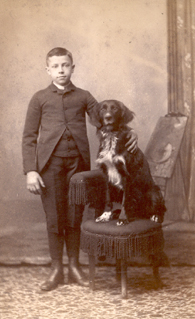
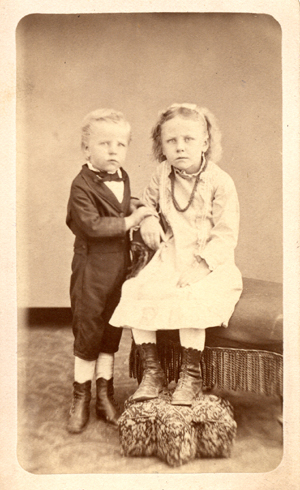
Homer was born on March 17, 1874 and grew up in the village of Poland in eastern Ohio. He was second from the youngest of the 5 children of Samuel Hine and Emma Kirtland-Hine and had 3 brothers and a sister. He also had a half brother and a half sister from his father's first marriage who were grown and living on their own by the time Samuel married Emma who was 25 years younger than her husband. Samuel, Emma, and the 5 children were a close knit family and the children would stay close their entire lives. Both parents had descended from prominent local families who had been early and accomplished settlers of what would become northeastern Ohio starting around 1800 before statehood and when the location was known as the Connecticut Western Reserve. Homer's father Samuel was a successful local businessman, landowner, and farmer and the family lived in a large home on Main St. in Poland on several hundred acres of land. Today the old Hine home in Poland is listed on the National Register of Historic Places. It was occupied by Kirtlands and then Hines for 110 years from when it was built in 1845 till 1955. In the late 1800's Poland was a small yet established community about 8 miles from the more rapidly expanding community of Youngstown. Today Poland is effectively part of the greater Youngstown area though it retains it's separate legal identity and small town character.
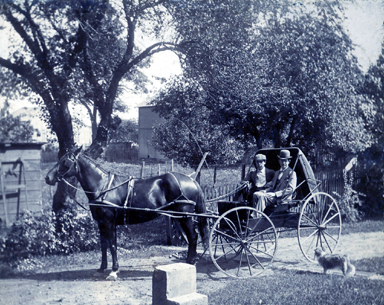
In a 1977 oral history interview my father related stories of his father's youth in Poland including the fact that the 4 Hine brothers would cut blocks of ice in the winter from the nearby creek and haul them to the family ice house which provided ice and cold storage all summer. Homer would also take the farm produce by horse and wagon via the long bumpy road to Youngstown where it was sold. I was aware as a child visiting Homer in Seattle in his later years that he was blind in one eye. My father told of how Homer had attempted to build a rifle in his youth from a piece of pipe and had damaged his eye when the powder charge blew out the end of the pipe closest to his eye. While Homer couldn't see with one eye, this fact wasn't apparent to others as both eyes appeared to function normally. A letter has survived that was written in
1887 by 13 year old Homer to his 15 year old brother Alfred in which he
describes some of the things going on in his life at the time.
Homer's Education
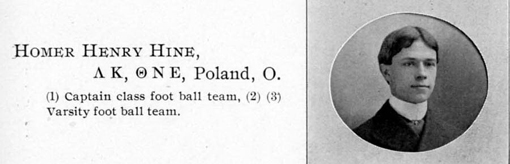
Homer's father was financially secure and could afford to educate his 5 children with, I believe, all attending private high school and all the boys graduating from college. Artifacts which I found among my aunt Ruth's stored family documents and photos paint a picture of Homer's education. He attended grade school in his home town at the Poland Union School and then for high school attended the Episcopal Academy of Connecticut in Cheshire, CT (also known as the Cheshire Academy) as a boarding student. (Today the school is known simply as Cheshire Academy and is one of the oldest private schools in the country having been founded in 1794). Homer graduated from high school in 1893 at about the same time his father Samuel passed away at age 77. A report card dated Dec. 20, 1893 has survived indicating that he attended Oberlin Academy (in Oberlin, OH) for at least the fall semester that year, probably as a boarding student due to its distance from Poland. He only took math, physics, and chemistry suggesting that he may have needed these courses as college entrance requirements which he perhaps hadn't completed or weren't available in Connecticut. My father indicates in his oral history interview that his father had a degree in electrical engineering from the Case School of Applied Science in Cleveland, OH (today known as Case Western Reserve University). I contacted Case and their archives show that Homer was in fact an electrical engineering major, was enrolled for the 4 school years from 1894/95 through 1897/98, was a member of the Lambda Kappa and Theta Nu Epsilon social fraternities and that he played football. Case's records however aren't clear as to whether he actually received a degree since he is not shown on the 1898 commencement program even though he does appear in the 1897/98 senior yearbook. He also appears over the years in their alumni directories which strongly suggests that he did graduate. Perhaps he lacked a few credit hours and didn't officially graduate with his class making them up and officially graduating later.
My father used to tell a story about his father's days as a college football player. Homer was shorter in height than most men which made him an unlikely football player. As a means of taking advantage of his much smaller stature and weight his teammates devised ways of having others pile up on the ground during a play to crate a platform of sorts and then, with the help of others, Homer would climb or be launched over them carrying the ball to gain a few extra yards. Homer's Work Life and Early Days In Seattle
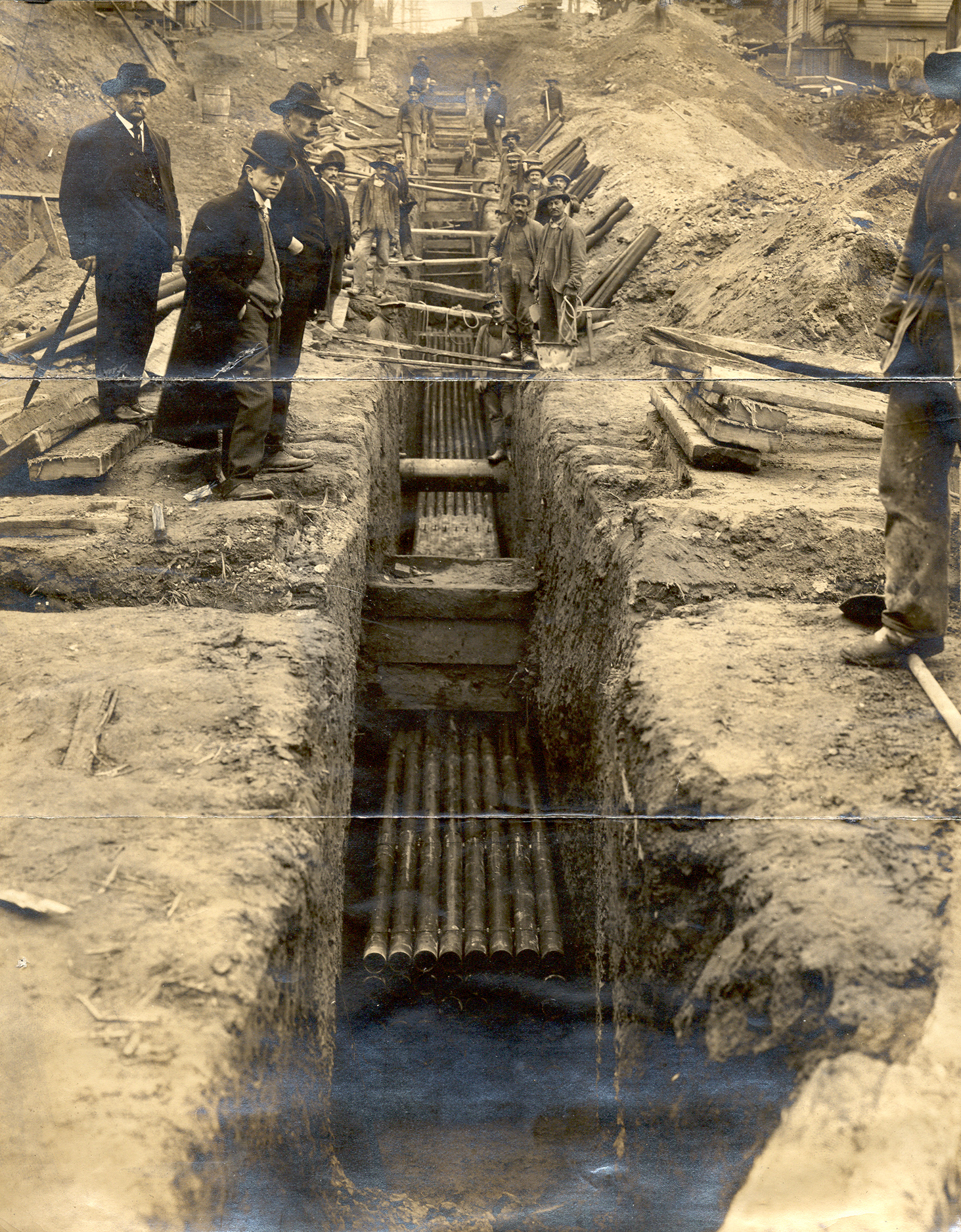
A little history is in order to put Homer's first carreer in perspective. Alexander Graham Bell was issued the patent for the telephone in 1876 when Homer was 2 years old. This patent would expire in mid 1890's a few years before Homer graduated from college with his degree in electrical engineering. The expiration of the patent enabled the entry of many new competitors into the fledgling yet rapidly growing telephone industry as towns and cities everywhere rushed to build infrastructure and install this huge technological advancement. Anyone with the right education and skills was in demand and this included Homer who started in the industry right out of college. In those days working in engineering for a phone company would have been considered a relatively high paying and glamorous job in a "hi-tech" field of the day with lots of opportunity for advancment. One source indicates that Homers first job was with the
Westinghouse Electric Co, in Pittsburg.
An undated (but certainly from the later 1890's) and
un-sourced surviving newspaper article indicates that Homer had been working as
an "assistant engineer" for the Youngtown Telephone Co. but had just landed a
position as "chief engineer" with the People's Home Telephone Co. of Birmingham,
Alabama.
During his early years in Seattle Homer's living accommodations were a little out of the ordinary. From around 1904 till perhaps the time he married Rose in 1910 he lived with 7 other "bachelors" aboard a leased upscale and apparently huge houseboat on the shore of Lake Washington not far from downtown Seattle. The houseboat was apparently larger than many houses in Seattle and included a huge stone fireplace and a grand piano. The bachelors, all outdoor enthusiasts like Homer, engaged the services of a full time live-in Chinese cook. Homer saved two newspaper clippings documenting his floating home, the first from around 1904 when the bachelors first moved in and the second from 32 years later in 1936 when all 8 former house mates got together for a reunion.
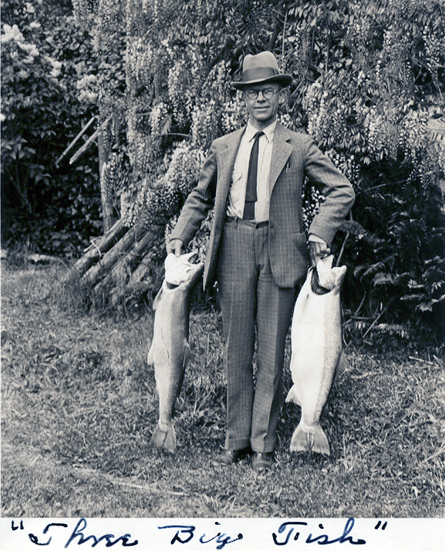
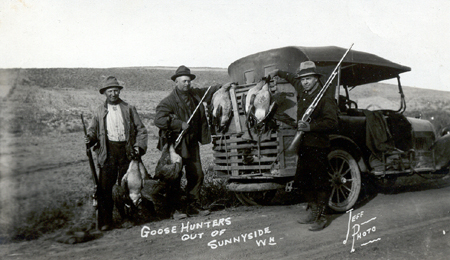
Both my father Kirt and his sister Ruth have indicated that Homer was an avid outdoor enthusiast. He loved to hunt, fish, play golf, and do almost anything else outdoors and the Pacific Northwest in the early 1900's provided the perfect place for him to partake in such activities. Evidence from Homer's photo collection confirm his outdoor activities. He met his houseboat roommates at the Seattle Athletic Club and apparently spent much of his free time on outdoor adventures with them in his bachelor days.
Confirming much of my research into Homer's early days I recently discovered a reference to him in a book published in 1907 titled "20th Century History of Youngstown and Mahoning County, Ohio and Representative Citizens" by Gen. Thos. W. Sanderson. In the section covering the Hine family part of page 960 reads: "Homer Henry Hine, superintendent of the Independent Telephone Company, at Seattle, Washington, for the past five years, prepared at Cheshire, Connecticut, remaining three years, at Oberlin College, remaining one year, at the Case School at Cleveland, where he studied four years. His first work was with the Westinghouse Electric Co, at Pittsburg, again for a short time in Youngstown, Ohio, and subsequently for a year and a half at Birmingham, Alabama." Finally, a little bit of speculation regarding this period of Homer's life and why he ended up in Seattle. Homer had a half sister named Mary Wick Hine. Mary was Samuel Hine's daughter from his first marriage, was 28 years older than Homer, and had married and moved away from Ohio 3 years before Homer was born. It's thus not known whether Homer knew his half-sister well. Mary had 3 children with her first husband, Allan Cameron, and the couple ended up living on a farm in Missouri. After Allan Cameron passed away Mary married James Phelps, possibly in Missouri. A 1907 historical reference about Mary states "Mr. Phelps spent some time in the Alaska gold fields, but now is a resident of Seattle, Washington." The 1914 obituary of Homer's mother Emma states that her step-daughter Mary Phelps was living in Seattle. The Alaska (Yukon) gold rush took place from 1896 to 1899 and Seattle was a staging area for it as well as the location where many that participated settled after the gold "bust". I have no dates for Mary's second marriage but I wonder if it's possible that she may have moved to Seattle during the gold rush and that she thus may have encouraged her half brother Homer to move there around 1900. I suppose it possible that Homer and Mary could have known each other in Seattle for decades though I have no information as to how long James and Mary Phelps lived there nor when and where Mary died. Rose's Early Years Rose Turner was born on February 18, 1875 at Walla Walla in what was then the Washington Territory. She was the eldest of the 5 children of Edward John Turner and Martha Hillman-Turner. In 1877 at the age of 2 she moved with her parents and infant brother Eddie via horse and wagon to southeast Idaho where the family became some of the first settlers there. Having started there with substantially nothing, Edward J. Turner would over the following decades become a highly successful local rancher and civic leader. The Turner's initially small homestead would over the years became a 1200 acre cattle ranch on the banks of the Bear River in what became know as the Gentile Valley in the larger Gem Valley of Idaho about 16 miles southwest of Soda Springs and about 4 miles southwest of today's Grace, ID. Rose's early childhood was thus spent on the frontier and I expect was full of the hardships and isolation which this implies.
I knew nothing of Rose's childhood till in around 2002, while researching my late mother's ancestors, I was digging through her old artifacts and came upon two small undated pages of short, cryptic notes in her handwriting regarding my father's mother (Rose) and her parents. It is highly likely that these notes were written in 1942 shortly after my parents married and when mother first traveled from New Jersey to Seattle to meet her new in-laws, Rose Bell Turner-Hine and Homer Henry Hine. These notes shed some light on Rose's early years. Here is a translation, as best as I can tell, of my mother's handwritten notes regarding Rose. Notes in [brackets] are mine:
Since there would have been no schools in the Gentile Valley when the Turner's settled there it's not surprising that Rose would have attended school elsewhere and apparently her father could afford the cost. My mother's notes suggest that Rose first attended school in Wisconsin (where her father grew up and attended a private high school and college) however I've found no proof of this. On the other hand other evidence confirms that she did attend New Jersey Academy, a Presbyterian boarding school in Logan, Utah for perhaps as long as 8 years in the mid to late 1880's and early 1890's. A little research confirmed that New Jersey Academy did in fact exist in the late 1800's and on July 25, 2006 I received the following email from a successor school:
Logan, UT was about 80 miles south of the Turner's Idaho ranch. Historical records indicate that the railroad arrived in the Gem Valley in 1884 so I think that Rose was probably able to take the train south to school and back as necessary but certainly not on a daily basis so she would have been a boarding student in Utah. I note that in a 2003 oral history I recorded with my aunt Ruth-Hine Darling she suggests that her mother may have lived with an aunt in Logan but I've found no evidence of this and think it very unlikely based on my research into her parents. According to my mother's notes Rose taught pump organ at ranches in rural southeastern Idaho earning 25¢ per hour.
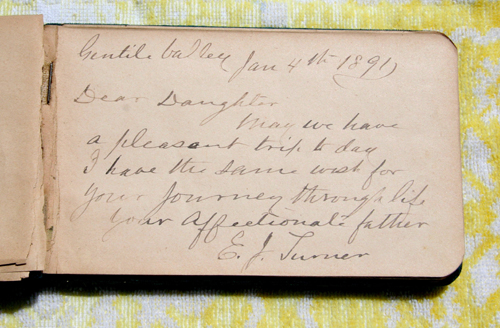
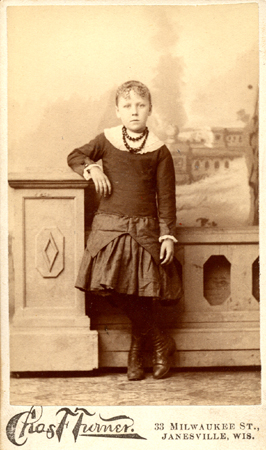
In the summer of 2006 my first cousin, Ellen Darling-Benson, loaned me our grandmother's two "autograph books" which had been passed down to her so I could digitize them. These books contain entries made by Rose's friends and family during the period from 1886 to 1893 when she would have been from about 11 to 18 years old. These books and a few photographs are the only artifacts that I'm aware of that have survived from the Rose's youth. They confirm that Rose attended New Jersey Academy in Logan, UT and provide much information regarding the Turner family that I found invaluable in tracing Rose's fraternal aunts and uncles in Idaho (which is discussed in more detail in the biography of Rose's parents).
A few final notes regarding Rose's early years. While I always knew my grandmother simply as Rose, in the course of my research into her and her parents I've run into a number of different versions of her name including Rosabelle, Rosa, Rosie, and Rosy. In her 2003 oral history interview regarding her mother, Ruth Hine-Darling indicates that Rose was initially known as Rosabelle but that in later years she shortened the name to Rose and added the middle name Belle.
Rose grew up in an area heavily settled by Mormons but I have no information that the Turners as a family or Rose as an individual were members of the Mormon church. In fact the name given to the geographic area where Edward J. Turner settled ("Gentile Valley") with his family after their arrival in Idaho suggests the Turners were likely not Mormon as the term "gentile" is used by Mormons to refer to non Mormons. Not a lot of information was passed down to Rose's children (and thus to me as a grandchild) regarding their Turner grandparents and when I asked daughter Ruth Hine-Darling why this might have been in 2003 she indicated that she thought that Rose wasn't particularly proud of her Idaho roots and the Turner family and was somewhat ashamed that they were mere farmers/ranchers. Rose apparently didn't talk about them much. I suppose that Rose's upbringing on the Idaho frontier may have been somewhat harsh due to the location and circumstances, particularly as compared to life in Seattle with Homer who was well educated and prosperous. On the other hand, Rose's father had attended college, had turned raw land into a successful cattle ranch, was a well respected and relatively well off member of his community, and (after Rose had married and moved on) was appointed an Idaho Water Commissioner. Additionally, my extensive research of the Idaho Turner's uncovered nothing that would suggest that the family was in any way dysfunctional. Rose's First Marriage Rose's marriage to Homer Henry Hine was her second. Her first marriage was to Guy B. Higgins (b. 1868) and they had no children. Idaho marriage records show that they were married on June 25, 1896 in the Gentile Valley, perhaps at the Turner Ranch or a small nearby church. (My mother's notes suggest that they were married in Idaho Falls but this must be in error.) Rose would have been 21 years old at the time of her first marriage and Guy Higgins 28.
Mother's notes then reads "newspaper at Pocatello Idaho. Then to Boise - then to Seattle. 1st husband died on hunting trip. Yukon expedition 1908 in Seattle." suggesting that the couple spent time in several locations before ending up in Seattle. Rose's obituary indicates that she came to Seattle in 1902 however census records show her and her husband there in 1900 but in an unexpected way. Rose and Guy are shown living separately in 1900 yet very near each other in the same Seattle neighborhood, each as a "lodger" in a boarding house. Both are shown as being married for the correct length of time and all their other census information is correct so there is no doubt that I've found the correct records for them. Rose is shown living with 18 other lodgers (both male and female) and Guy with 4 lodgers (all male). I can only speculate as to why they were living separately yet so physically close. Perhaps they had just arrived in Seattle and these were the only living accommodations they could immediately find. Family oral history records that Guy Higgins passed away from appendicitis while on a hunting trip with his friend (and Rose's future husband) Homer Hine. Guy's recently obtained obituary confirms this and documents Homer's possibly heroic attempt to save his friend's life while on a 12 mile hike in the mountains far from the nearest medical help.
Washington State death records show that Guy B. Higgins died on September 22, 1909 at Sultan, Snohomish County, WA which is located about 50 or 60 miles north east of Seattle. At the time of his death Guy Higgins was employed in the composing room of the Seattle Post-Intelligencer newspaper as an "assistant makeup man" and was a member of the Seattle Typographical Union. Guy and Rose lived at 532 Broadway North in Seattle at the time. Till I found Mr. Higgins' death record and obituary I'd interpreted the part of my mother's note which reads "Yukon expedition in 1908" to be the time and place of Guy Higgins' death but perhaps this was a previous trip Guy and Homer had shared. Guy and Rose had been married for a little over 13 years when he passed away and the couple had no children. Less than a year after Guy's death Rose would marry his friend Homer. Homer and Rose's Marriage Homer Henry Hine and Rose B. Turner-Higgins were married on June 3rd, 1910 in Spokane, Washington. At the time Homer was 36 years old and Rose 35. Why they were married in Spokane, located about 300 miles east of Seattle near the Idaho border, is a mystery as both had lived for some years in Seattle and neither had relatives in the Spokane area or other connections there that I'm aware of. Their wedding certificate indicates that both Rose and Homer were residents of King County (in which Seattle is located) and that they even obtained their wedding license in Seattle on May 31 before going to Spokane where the wedding ceremony took place on June 3, 1910. Perhaps the couple had chosen to honeymoon there or perhaps it was a midpoint easily accessible by both the bride & groom and Rose's Turner parents and siblings who were living in southern Idaho. I have no information about whether any guests may have attended the wedding.
Early Married Life After the wedding Homer would continue
working for the phone company and the couple's first child, daughter
Ruth Emma Hine, was born on December 28th, 1911, a year and a half after their
marriage. Homer was an avid amateur poet and the oldest surviving
poem that I've come across was written on Christmas day 1912 to his daughter
Ruth when she was 3 days from her first birthday.
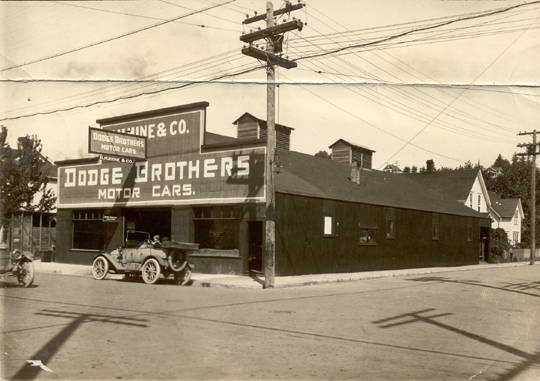
Mt. Vernon and the Dodge Dealership My father, Edward Kirtland Hine ("Kirt"), was born on September 1, 1916 almost 5 years after his sister Ruth. When their son was born Homer was 42 years old and Rose 41, quite old to be new parents. Kirt was born in Mt. Vernon, Washington (about 60 miles north of Seattle) during a couple of year period when Homer and Rose lived there. Around the time of Kirt's birth Homer apparently decided to make a career change, had left the phone company, and acquired a Dodge Brothers Motor Car dealership in Mt. Vernon, likely with savings from his high paying phone company job and/or with the proceeds of his parent's estate, his mother having passed away in late 1914. This car company in later decades would come to be know simply as Dodge. Historical records show that Dodge's first cars were sold in 1915 and quickly became popular with the driving public so Homer perhaps figured he was getting in on the ground floor of a good business opportunity. For reasons that aren't completely clear sometime after May of 1918 when Roses father's estate records show the Hines were still living in Mount Vernon, Homer moved the family back to Seattle and presumably sold the auto dealership after only a couple of years. Daughter Ruth indicates in her oral history interview that her mother Rose didn't like living in Mt. Vernon but I suspect there was more to the decision to exit the auto business. Perhaps with Dodge rapidly becoming a hot selling car, someone had offered Homer a nice profit to sell. When they returned from Mt. Vernon the family moved back into the home at 707 23rd North in Seattle suggesting that it had never been sold during their more or less 2 year absence. Perhaps they had rented it. Salmon Bay Sand and Gravel Co. Upon returning to Seattle Homer purchased an interest in the Salmon Bay Sand and Gravel Co. which, as the name implies, sold earth based building and construction materials probably including pre-mixed concrete in the Seattle area. Homer's 1958 obituary indicates that his association with Salmon Bay started about 40 years before which would have been about 1918. Involvement with such a company supporting the construction industry would certainly have been a logical extension of Homer's experience supervising construction for the phone company. I have no conclusive documentation but I recall my father saying that Homer owned half the company and had a partner in the business whose name I don't ever recall hearing. Both Homer's obituary and Case School of Applied Science alumni directories (which, along with other sources, refer to him as "president") suggest that he owned his share of the company until his death. While he retained his ownership stake and apparently the title of president, it's clear that in later years Homer was inactive in the company's day-to-day operations. To the best of my knowledge the Salmon Bay Sand and Gravel Co. was his only source of income after his venture into the auto business and until 1942 when he became a beneficiary of a trust set up upon the death of his brother Samuel. As I write this the company is still in business and it's website indicates that it was founded in 1907, is still located in it's original location only a few miles from the 707 23rd North house, and that it is a 4th generation family owned business. I suspect that Homer's partner likely purchased his stake in the company from Homer's estate upon his death under the terms of a previously negotiated legal agreement typical in such business structures. Life in the 1920's
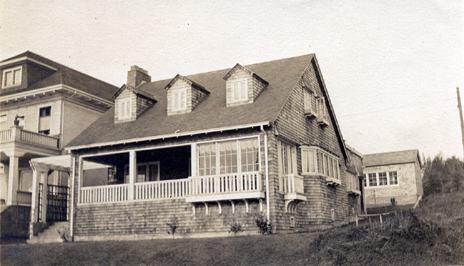
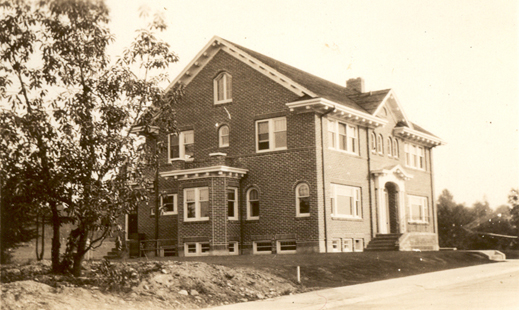
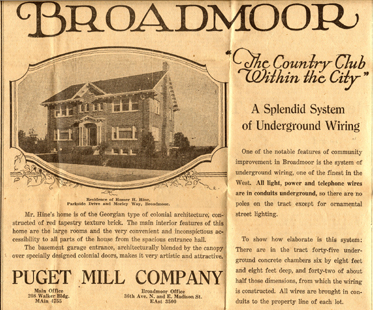
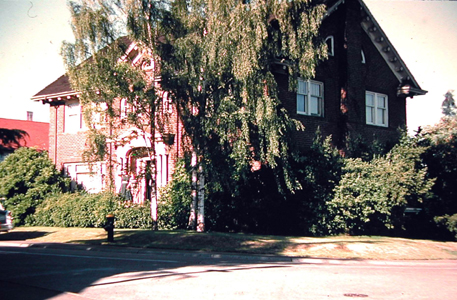
Business at the Salmon Bay Sand and Gravel Co. was likely booming in the 1920's as Seattle's population continued to grow and Homer and Rose were eventually able to afford a new home in one of Seattle's most exclusive communities. In about 1927 they had built and moved into a new home at 1204 Parkside Drive in the Broadmoor neighborhood where they would live the rest of their lives. Broadmoor was a very exclusive limited access gated community. Guards were employed to monitor and limit access through the gates and I recall them well from my visits as a young child in the 1950's. If the friendly guard knew you, he'd wave you through the gate but strangers weren't allowed in unless a resident authorized them. The Hines built on a corner lot near the golf course and I expect that Homer's connections in the construction business were valuable in having the home build. Daughter Ruth has indicated that this was her mother's dream house and that Rose keep a keen eye on it's design and construction, sometimes making changes that effected work-in-process as the house was built.
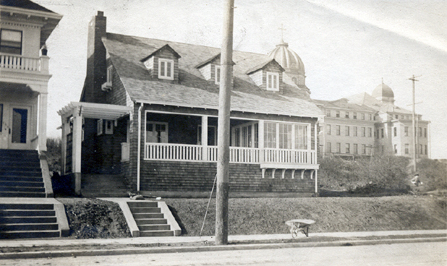
Perhaps the Broadmoor house couldn't be called a mansion but it certainly was a large house. It had 4 stories if the full basement and attic are included and I remember the home well from my childhood visits. The main level included a large living room with fireplace, formal dining room, and big kitchen. The second story contained a huge master bedroom and bath suite along with bedrooms for the two children (and perhaps a guest bedroom). In the attic there were finished maids quarters (bedroom & bath) and a semi finished room my father used as a child as a "radio-shack" to tinker with his electronic experiments in the early days of radio. The full basement included a one car garage and large utility areas.
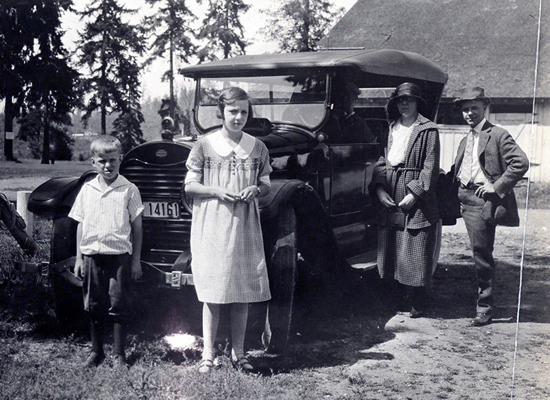
At the time that the Hines moved to Broadmoor daughter Ruth was about 16 years old and son Kirt about 11. In the 1920's Homer was able to afford to send his children to private schools. Ruth attended the St. Nicholas School in Seattle (a private girls school) through high school and then started at Scripts College in southern California. Kirt attended Seattle's Lakeside School (an all boys private grade and high school) starting in the fall of 1929. I believe both Ruth and Kirt attended high school as day students and lived at home. Homer, being an outdoorsman by nature,
regularly took his family places where they could enjoy the outdoors. When
I was young I recall my father periodically and fondly mentioning "Lake
Crescent" which I understood to be a place he frequented as a child with his
parents. Among Homer and Rose's artifacts saved by my aunt Ruth I
ran into a brochure from a resort named Ovignton's on Lake Crescent on
Washington's Olympic peninsula. The brochure is undated but I suspect from
the 1920's.
The 1920's were apparently good years for the Hine family.
Homer's Outdoor Activities Homer was quite the outdoorsman.
Photographic evidence as well as family oral history suggests that his favorite
recreational activities included fishing, hunting, and golf which he enjoyed at
every opportunity. I don't recall ever hearing that Rose was much
interested in such things and I note that she doesn't appear in any of the
couples surviving photos depicting outdoor activates.
The 1930's The stock market crash in late October of 1929 ushered in the Great Depression of the 1930's and while the Hines would survive these years pretty much intact, their financial condition would become stressed. While I never heard it specifically, it's not hard to speculate that the Depression would have had a major negative impact on the Salmon Bay Sand and Gravel Co. due to it's dependence on the construction industry which was seriously impacted throughout the 1930's. Daughter Ruth was forced for financial reasons to drop out of Scripts College in California and finish her education at the University of Washington were she could save on tuition and cut expenses by living at home. Son Kirt would attend college at Yale University in Connecticut from 1935 to 1939 but virtually all of his tuition and expenses were paid for by a scholarship there set up by a Kirtland relative and by his uncle Samuel Kirtland Hine (one of Homer's brothers in Ohio also known by the nickname "Kirt").
Homer apparently liked beer which became unavailable in the United States during Probation from 1920-1933. My father, who with a childhood friend grew up racing two person sailboats, used to tell a story about how, with his father's apparent approval, he'd sail home from races in nearby Canada (probably at Vancouver Island) with the sail boat's bilge full of beer bottles hidden under the floorboards. Since my father wasn't much of a beer drinker he'd give the contraband to Homer who enjoyed it immensely. I suspect that this was probably in the early 1930's.
While money was apparently tight during this period, Homer and Rose did manage to afford the services of a live-in servant. Both my father and Ruth have mentioned that their parents always had live in domestic help after moving to Broadmoor who, I presume, did chores like cleaning and cooking. I recall my father telling of a Japanese maid who, after working for the Hines for some years had taken a "short" vacation to visit relatives in Japan just before World War II and had never returned and was never heard from again. I suspect that in those days a live-in servant, particularly of foreign origin, was probably not terribly expensive. The Broadmoor house had maids quarters on the third floor and the Hines probably only had to pay for food and provide a little spending money to retain a servant. The Artic Club Over the years both Ruth and Kirt passed
along to their kids (my generation) the fact that neither remember their father
Homer "working" as such during the years they were growing up and old enough to be aware
of it. The story they passed on is that Homer would get up in the morning and
head for the Artic Club in downtown Seattle where he would spend the day.
The Artic Club was a gentleman's social club for adventurous outdoorsman with
connections to the Klondike Gold Rush and/or Alaska though it's not clear what
Homer's connection to either of these was. In looking into it's history I've learned
that the club was a substantial organization which operated from 1908 till 1971.
In 1916 the club built a 9 story building for it's activities in downtown
Seattle which today has been restored and is operated as a fancy hotel.
Homer would spend his days there playing cards and chatting with friends and
local businessmen and I suspect both Homer and Rose attended the numerous social
activities the club regularly sponsored.
Since Homer had no other visible means of support during this period I suspect that he must have been getting income from the Salmon Bay Sand and Gravel Co. even if he wasn't active in day-to-day operations. The 1936 newspaper article about the house boat bachelors reunion (above) clearly states that Homer was the "president of the Salmon Bay Sand and Gravel Company" that year. I suspect that being president was perhaps a somewhat honorary position for Homer as half owner and that his duties were limited. He was probably supporting his family on his half of the firms profits after paying his active partner a salary. He may have performed his duties as president in occasional meetings with his partner at the Artic Club but this is just speculation. Homer managed to keep food on the table during the 1930's and hold onto the Broadmoor house but didn't have money for much else. Relationships with Extended Family
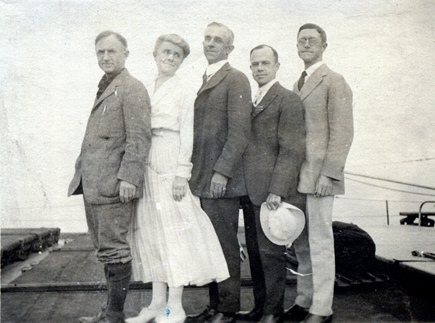
As mentioned previously, Rose apparently wasn't very close to her parents and siblings. In her 2003 oral history interview daughter Ruth suggested that Rose wasn't proud of her Idaho roots, parents, and siblings referring to them as mere farmers/ranchers (thought my research into the Turners shows no particular reason for this as her father was quite successful). For whatever the reason, I've run into little evidence that Rose communicated much with her Idaho parents or siblings. The only definite indication I have that Rose ever visited her family in Idaho is in her first husband's obituary which says she was visiting her "parents" (likely only her mother) in Weiser, ID at the time of his death. I have no indication that any of her immediate Turner family ever visited the Hines in Seattle (though a son of Rose's brother Edward did stop by for a day in Seattle after being discharge from the Navy shortly after World War II in 1946.) Additionally, daughter Ruth specifically indicated in her 2003 oral history that she never visited her Turner grandmother, uncles, aunt, or cousins in Idaho and thus never knew them. In researching Rose's father Edward J. Turner I did run into clear evidence that Rose was included in his will and did in fact get her share of his estate after he passed away in 1916. Other than this the Turner family was apparently pretty much invisible as far as the Seattle Hines were concerned. In contrast, Homer remained very close to his Ohio family even though they were thousands of miles away. After his mother's death in 1914 his unmarried sister Nell continued to live in the family's Poland, OH home till her death in 1955 and Homer's 3 brothers spent their adult lives not far from there with Charles in Cleveland, Samuel ("Kirt") near Youngstown and Alfred in Pittsburgh, just across the Pennsylvania border. In her 2003 oral history daughter Ruth indicated that she visited her Ohio relatives multiple times as a child and that the Seattle Hines would typically drive to Ohio which would have been a long trip in the 1920's and 1930's in the early days of the automobile and before the days of the Interstate Highway system. Alternately, they could have traveled by train. There is plenty of photographic evidence of times when the Seattle Hines visited Ohio and/or family members visited Seattle from Ohio and one could assume that not all visits were recorded. Photos show that in 1911 Homer's mother Emma Kirtland-Hine was in Seattle around the time Ruth was born. Multiple photos show his brother Kirt in Washington in the 1920's and 1930's, sister Nell is shown in the area in 1925 and 1943, and the Seattle Hines are shown in Ohio in 1913 or 1914 and 1933. Homer's sister Nell documented a number of her visits to Seattle from Ohio in manuscripts she wrote in the mid 1940's. She wrote: "It was my great privilege to make a number of trips west to see Homer and later to visit in his home with Rose, a capable hostess and devoted mother to her baby Ruth Emma. In 1943 I visited Rose and Homer for a week and then Rose and I went to Leavenworth, Washington, where Ruth Emma, now Mrs. Tom Darling, lived with her fine husband and fascinating twins, Ann and Ellen." Nell continues: "When Mother and I went West on one trip, Kirt and Alma joined us, and Homer and Rose took us to Mt. Rainer and up to Paradise Valley where the flowers were lovely and snow clad Mt. Rainer most majestic. One memorable trip was when I visited Rose & Homer when they lived in Mt. Vernon, Washington and I motored with them to Jia Wana, Mexico, and then to Los Angeles where we took our steamer north." This suggests that Nell visited Homer in Washington at least 5 time over a number of decades. Among Homer and Rose's artifacts I came upon a photo showing all 5 middle aged Ohio Hine
siblings standing together. (See photo at above right.) There is no
inscription on the photo so its date and location are unknown. Also among
the artifacts is a letter written from Homer to Rose, also undated, in which
Homer talks about being with his siblings on a ship on Lake Superior while
apparently on an extended family reunion trip from Duluth, MN to Cleveland, OH,
a long voyage across 3 of the Great Lakes. The letter mentions Homer's
siblings as being there but none of their spouses. The photo looks like it
could have been taken on the deck of a ship so I suspect that the photo was
probably taken on the same trip as the letter was written. With no dates
specified I suspect that the trip probably took place in the 1920's. To
view the letter, see page 14 of my collection of Homer's poetry.
Homer & Rose's Later Years
By the early 1940's Homer and Rose were in their mid 60's and the children were through college, had married, and were living elsewhere with Ruth in Leavenworth, WA just east of the Cascade mountains and Kirt in northern New Jersey. If Homer hadn't been technically retired previously from his minimal duties at the Salmon Bay Sand and Gravel Co. he must have been considering it by then and I suspect that World War II and the economic boom immediately following it were good for business at the sand and gravel company thus increasing Homer's income. He also had some additional help financially in his old age. Homer's brother Samuel Kirtland Hine, while perhaps not "wealthy" as such, had saved his money and made some good investments and over the years and had thus become reasonably well off financially. Samuel ("Kirt") and his wife Alma had no children and when he passed away in 1942 had, by the terms of his will, set up a trust which provided income for his widow as well as his surviving siblings. Homer's other two brothers (Charles and Alfred) also passed away in 1942 leaving only Samuel's widow Alma, Homer, and sister Ellen Louise Hine ("Nell") as beneficiaries of the trust's income. This helped provide Homer and Rose with the resources to live comfortably in their old age particularly after Nell passed away in 1955 and Alma in 1957 leaving Homer as the only recipient of the trust's income.
I was born in 1945 and the late 1940's and early 1950's were the years my father would take us kids to Seattle every few years to visit his parents and his sister and her family in Leavenworth, WA, trips that I remember well. In the years he couldn't take the entire family father would typically fly to Seattle to visit his family for a week each year without us. I don't remember Homer and Rose visiting us in New Jersey but there is evidence in a surviving letter that they did in 1948 when I was to young to remember while also visiting Nell Hine in Poland, OH. I don't recall my grandparents ever having pets the few times I visited in their later years. Ruth mentions in her oral history having a dog for a time when she was growing up and there is a cat in a photo of Rose I have taken in 1964 but in general I have the impression that pets weren't an important part of Homer and Rose's life. Additionally, I have no recollection of Homer and Rose being religious and my father certainly wasn't suggesting that religion might not have played much of a roll in my grandparents lives. I also don't recall ever hearing what their political leanings may have been. By around the mid 1950's Homer and Rose apparently had more income then they needed from Samuel Hine's trust and the Salmon Bay Sand and Gravel Co. so, as a means of legally avoiding inheritance taxes by skipping a generation, Homer set up trusts for myself and my brothers and also, I assume, his other grandchildren (the 4 children of his daughter Ruth). Each year Homer would distribute to a trust set up for each grandchild the maximum allowed by law that could be given without incurring gift taxes. I was quite young at the time but recall that each year about $3,000 (in mid 1950's dollars) would transfer to each grandchild's trust account which was controlled and administered by my father (and I presume Ruth for my cousins). This arrangement was in effect for only a few years before Homer passed away. Thus, while my trust didn't accumulate a lot of money, a few years of annual principle deposits in a savings account and the interest over 10 or 15 years provided a nice next egg which was handy when my brother and I started a business in 1972.
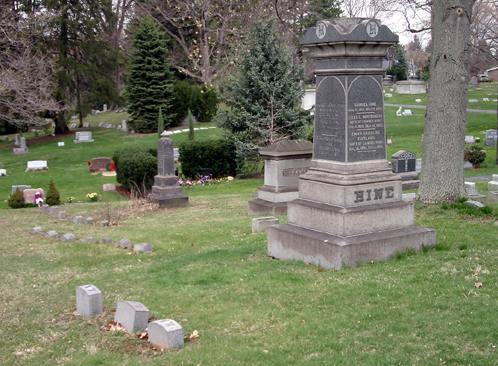
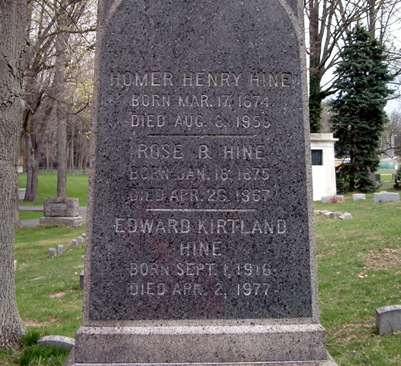
A surviving letter written by Rose to son Kirt in November of 1952 indicates that Homer was in a sanitarium for several weeks recovering from a "mental breakdown" with no other details given. He must have recovered since he seemed fine to me 3 years later when my family visited Seattle in 1955 (thought I was only 10 years old at the time and might not have picked up on subtle medical issues). Homer passed away on August 08, 1958 at the age of 84. I don't recall ever knowing the cause of death (other than "old age") but remember well when it happened as my family was vacationing at a fishing camp in Maine when the news arrived and my father had to leave us there while he flew to Seattle to take care of things. Homer was cremated and buried in the Riverside Cemetery in Poland, Ohio in the Hine family plot with his parents, several siblings, and other relatives (see below).
After Homer's death Rose continued to live in the Broadmoor home till her death in 1967. Homer had been the last surviving beneficiary of the trust his brother Samuel had set up in his 1942 will and Homer's death caused the assets of the trust to be distributed to Rose and the children of Homer and his siblings (with part also going to the Village of Poland, Ohio). Between 1942 and 1958 the value of the securities Samuel had left in the trust had increased substantially in value insuring that Rose's share of the estate's distribution along with the proceeds from the sale of Homer's interest in the Salmon Bay Sand and Gravel Co. was more than adequate to provide for her even when she needed full time care. Rose would have a full time live-in care giver named Doris from around the time of Homer's death till she passed away. I remember Doris well from the few times I visited in the 1960's.
In his later years my father Kirt used to like to tell a story to friends (usually over evening cocktails) related to his mother about a year or so after Homer's death. Father decided that Rose, then about 85 years old, needed a new and reliable car for her care giver to drive her around in so on his annual visit to Seattle he bought Rose (with her own money I suspect) a brand new Mercedes Benz, then and now an expensive and in theory a very reliable luxury automobile. Kirt picked up the brand new car at the dealer's showroom and, on his way home to deliver it to his mother, stopped at a country club to play a round of golf with a childhood friend. As Kirt was driving the new Mercedes into the country club's driveway there was a loud "clunk" under the car and it ground to a halt. A quick look under the vehicle showed that the drive shaft from the transmission to the rear axle had come off at one end, apparently the result of someone at the factory failing to adequately tighten the bolts which held it on. Father immediately called the dealership from the clubhouse and received a sincere apology and was told it would be taken care of "immediately". Father played the round of golf with his friend and when he returned to the clubhouse the brand new Mercedes was in the parking lot, repaired and ready to go. The dealer in a matter of a couple of hours had towed the vehicle to the dealership, fixed it, and delivered it back to the country club. In the years after the purchase father used to joke that this Mercedes had become the proverbial low mileage used car that "was only driven by a little old lady to church on Sundays". In this case it was only driven by Doris to do shopping for Rose and very occasionally to drive Rose to the doctor's or other appointments.
Rose passed away at age 92 on April 26, 1967 in Seattle. Her Seattle obituary read: "Mrs. Rose B. Hine, 92,
of 1204 Parkside Drive, died Wednesday. Born in Walla Walla, she was raised in
Soda Springs, Idaho. She came to Seattle in 1902. Her husband, Homer
Henry Hine, died in 1958. Survivors include a daughter, Mrs. Thomas K. Darling,
Leavenworth; and a son, Edward Kirtland Hine, Garrison, NY. Services: Private
Friday, 11:00am, Bonney-Watson Central; cremation, with internment in the family
plot, Poland, Ohio."
Rose's adult years in Seattle had been lived in stark contrast to her childhood on the Idaho frontier.
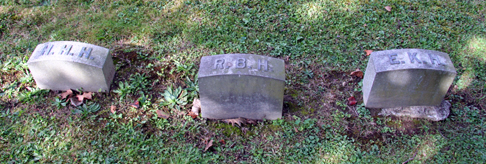
Final Resting Place Homer and Rose are buried in the Riverside Cemetery in Homer's childhood hometown of Poland, Ohio. The cemetery is located only a few blocks from the house Homer grew up in. Both Homer and Rose were cremated. The Hine family plot is also the final resting place of Homer's parents along with and his father's first wife, a brother, his sister, and his son Kirt (Edward Kirtland Hine, my father). The Riverside Cemetery is also the final resting place of numerous other Kirtland and Hine relatives and ancestors.
About Homer and Rose's Children Ruth Emma Hine- Darling (1911-2012): I suspect that Ruth's
first and middle name were derived from Homer's grandmother Ruthanna
Frame-Kirtland and Homer's mother Emma Kirtland-Hine. Ruth grew up in Seattle and
attended Scripps College and the University of Washington before taking a
teaching job in the tiny town of Leavenworth, WA in the mid 1930's. There
she met Thomas K. Darling whom she married at her parents home in Seattle in late
December of 1938.
Edward Kirtland Hine ("Kirt", 1916-1977) Kirt's first name Edward
very likely came from Rose's father Edward J. Turner. His middle name
was Homer's mother's maiden name. My father Kirt grew up in Seattle before
attending Yale University in Connecticut where he earned a degree in electrical
engineering. After college he took a job in northern New Jersey with the
Curtiss-Wright Corporation where he designed propellers for military and
civilian aircraft for 20 years. He raised 3 sons, Edward K. Hine, Jr.
(myself, "Ted"), Gregory Seward Hine, and Henry Boardman Hine. I have
written a detailed biography of my father's life which can be found here.
|
||||||||||||||||||||||||||||||||||||||||||||||||||||||||||||||||||||||||||||||||||||||||||||||||||||||||||||||||