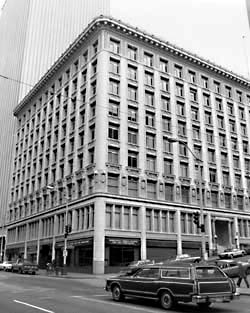
Arctic Building

From Wikipedia, the free encyclopedia
 
The Arctic Building is a nine-story building in Seattle, Washington located at the Northeast corner of Third Avenue and Cherry Street. The building was built for the Arctic Club in 1916 and was occupied by them from construction until the club's dissolution in 1971. It is entirely faced with cream white terra cotta with submarine blue and orange-brown accents. It is particularly noted for the terra cotta walrus-heads lining the third floor of the building. The building was recently restored and exists today as the luxury hotel, Arctic Club Seattle - a DoubleTree by Hilton] and is on the National Register of Historic Places.

The site of the Arctic building was originally owned by Joseph R. Lewis, the Chief Justice of Washington Territory and a direct descendant of George Washington's sister Betty. The home he built on the site in 1875 was considered one of the finest in Seattle at the time. The house was replaced in 1892 by The three-story brick Seattle Theatre designed by the firm of Saunders and Lawton. The newly formed Rainier Club occupied the office portion of the building until it and the theater were replaced by the Arctic Club Building in 1916.

The Arctic Club was formed in 1908 by successful veterans of the Klondike Gold Rush. The existing Alaska Club was also merged into the Arctic Club in 1908. The Arctic Club was a fraternal men's club for businessmen with Gold Rush or Alaska connections.[3] The Arctic Club was initially located in 1909, on 3rd Avenue and Jefferson Street in the Morrison Hotel, also known as the Arctic Club Building.

In 1914, after a dispute with the owner of that building, the Arctic Construction Company, it was decided to relocate. In 1916, the members commissioned noted Seattle architect A. Warren Gould to design the Arctic Building in downtown Seattle at Third and Cherry as the group's headquarters. James Moses was the builder. During the move, members surreptitiously removed the bar from the original location by hoisting it out one of the windows. The 128 ft. Arctic Club building's most striking feature is the walrus heads, indicative of the club's name, which adorn the third floor.




22

The Arctic Building is associated with one of the lesser-known facets of the Klondike gold rush--the formation of social institutions for the men who returned from the Yukon gold rush after "striking it rich." Though most who headed north found no gold, a small percentage did return to Seattle with more than just memories. The Arctic Club, originally located in the Morrison Hotel, provided an exclusive social community for those Seattlites who had returned from the Alaska Gold Rush with money in their pockets and a repertoire of stories to tell about their adventures in the Yukon. In 1916, they commissioned A. Warren Gould, one of the city's most prominent architects, to design the building that would become their institution's new home.

Gould created an eight-story building true to the club's origins: fine Alaskan marble covered its main corridors and walrus heads ran around the third-floor exterior. The Arctic Building was one of the earliest to use terra cotta panels placed over a steel reinforced concrete frame; however, unlike other early users of this technique (such as the Hoge Building), the Arctic Building sported not just off-white panels but also used submarine blue and orange-brown. The club's elegant interior included a ladies' tea room, private dining rooms, billiard and card rooms, a bowling alley, barber shop and private roof garden. The formal dining room, however, was always the focal point of the club, its stuccoed ceilings, which were artistically frescoed, the ornamented cornices and beautiful chandeliers speak of the rich history and foundations of this building. From its opening, the building also offered commercial space, but now offices have taken over the entire building including those floors once reserved for Arctic Club members. Despite its new use, the Alaskan marble and sculptured walrus heads still proclaim the building's origins--one part of the prosperity Klondike gold brought to Seattle.

The Arctic Building is located a block north of the Pioneer Square-Skid Road Historic District at 306 Cherry St. The building is open to the public during regular business hours.

Arctic Building
Photograph by Florence K. Lentz