Judge
Turhand Kirtland
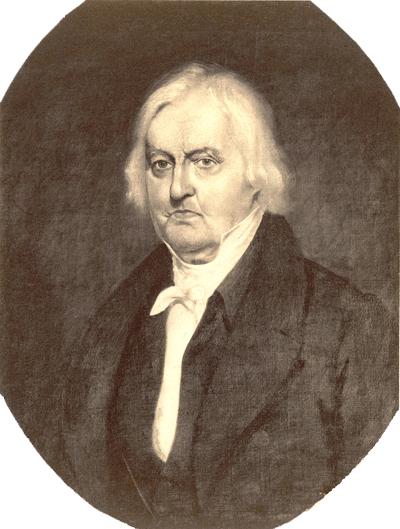
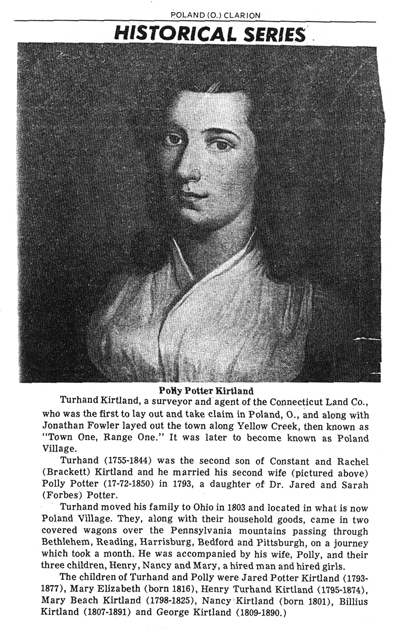
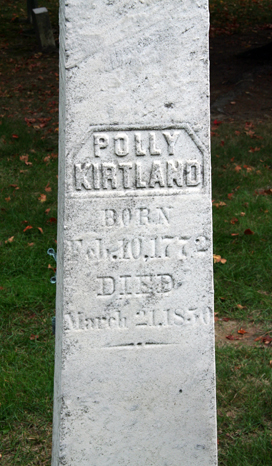
Introduction Turhand Kirtland was one of the early settlers in what would become the state of Ohio. There he became a prominent and well known citizen. He is considered one of early founders of the state as well as the Village of Poland, OH (today a suburb of Youngstown) where he settled with his family in 1803. I have uncovered many historical accounts regarding Turhand which, for the most part, are consistent but occasionally differ slightly in terms of facts and emphasis. What follows is a summary of my research which included bits and pieces from many sources. Early Years Turhand Kirtland was born on November 16, 1755 in Wallingford, Connecticut and was the second of the 10 children of Constant Kirtland and Rachael Brockett-Kirtland. Nothing is known about his childhood in Wallingford nor his education. The first written record of him that I've run into is regarding his service in the American Revolutionary War. According to the National DAR Society Lineage Book, Vol. 32 he "having been engaged on the boats, transporting the retreating army at Long Island in 1776 where he contracted camp fever, and was honorably discharged." In 1776 Turhand would have been 21 years old. Another source, the 2015 book "Jared Potter Kirtland" by Thomas Daniel about Turhand's son, records that Turhand "witnessed the British conquest of New York City and subsequent ravaging of Connecticut towns." Turhand returned to Wallingford where he went into the business of making carriages and stagecoaches, a trade he would have learned from his carriage maker father, and he apparently became quite successful at it over a number of years. Thomas Daniel's book indicates that during this period Turhand became "a well-known and respected member of the community". On January 21, 1780 he married Mary Beach who would pass away from unknown causes in 1882 and who bore no children. (I note that one source indicates that Mary Beach died a decade later in 1792.) Masonic records show that Turhand was an active Mason. It's recorded that "At Wallingford, Judge Kirtland had been Worshipful Master of Compass Lodge No. 9 in 1783, 1789, 1795, and 1800." and that when Connecticut's "Grand Lodge was organized on July 8, 1789 he was one of the signer of its constitution." Over a decade after the death of his first wife on January 19, 1793 Turhand married Polly Potter in Wallingford. Polly was the daughter of Yale educated and well regarded clinical physician Dr. Jared Potter and Sarah Forbes-Potter. At the time of their marriage Turhand was age 38 and Polly 21. Thomas Daniel's book says that "Polly was known in Wallingford and later in Poland, where they settled in the Western Reserve, as a gracious and well-educated lady. She was also an accomplished cook." (Like Turhand, Polly's father, Dr. Jared Potter, had served in the Revolutionary War, in his case as a surgeon with a Connecticut regiment seeing action along Lakes George and Champlain in Upstate New York. Thomas Daniel's book reads "Potter was commissioned in 1775 as a physician and surgeon in the 'First Regiment of the Inhabitants Inlisted [sic] and Assembled for the Special Defense and Safety' of the colony of Connecticut under the command of General David Wooster. He served in the northern campaign and took charge of a hospital in Montreal. Later he served at the Battle of White Plains. Ill with what was thought to be tuberculosis, he was discharged on April 15, 1776.") Over a period of about 20 years from late 1793 till 1813 Turhand and Polly would have 7 children. The first 4 were born in Wallingford and the last 3 on the Ohio frontier.
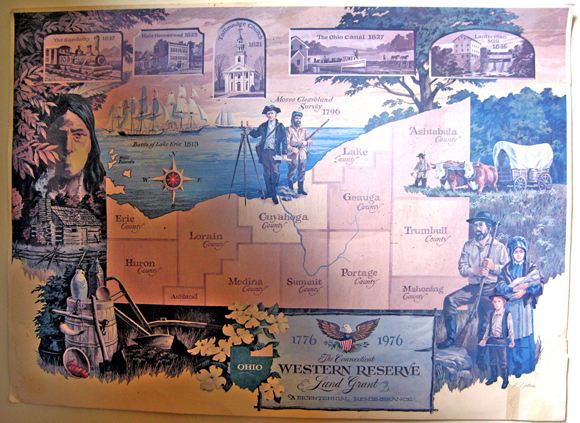
In the later 1790's when Turhand was in his early 40's he, for unknown reasons, made a major career change. Using the money earned over the years in the carriage business he invested in land in what was then known as the Connecticut Western Reserve and which would later become the northeastern most part of the state of Ohio. About the Connecticut Western Reserve and the Connecticut Land Company Starting in the 1660's the Connecticut Colony (and after the American Revolution the State of Connecticut) laid a sometimes disputed claim to land in the yet to be settled "Northwest Territory" (now the U.S. upper Midwest). Over time the claim changed somewhat but finally after the Revolutionary War and through complex negotiations with the new Federal Government and other states, the State of Connecticut obtained official title to over 3 million acres of land in what is today northeast Ohio. This became known as the Connecticut Western Reserve. Needing money to fund schools, Connecticut sold this land for $1,200,000 in 1796 to a group of investors who become collectively known as the Connecticut Land Company. The goal of this new business venture was to earn a profit for the investors by subdividing the land and re-selling it to individual settlers. In 1796 the company began sending their initial representatives into the area to scout likely areas suitable for settlement. The Connecticut Western Reserve was ripe for settlement. In the years following the American Revolution many in the 13 original States were looking to move west and build better lives for themselves and the Western Reserve had much to offer including it's inexpensive land and abundant natural resources including rivers and streams, hardwood forests, adequate rainfall for growing crops, and much wildlife for hunting. Around 1798 the Connecticut Land Company gave title to specific land areas to it's investors (which included sub- investment groups) through a kind of lottery. Turhand Kirtland, along with in some cases others as co-owners, was given land in major parts of what would become the Townships of Mecca, Auburn, Poland, Burton, and Kirtland (today a defunct township) as well as minor land amounts in other townships. (In the Connecticut Western Reserve townships were usually defined as a 5 mile by 5 mile area of surveyed land.) Turhand would play a lead roll in the Connecticut Land Company. In addition to being a landowner, he was retained by the Company as it's chief surveyor and primary land sales agent (selling land for other investors), positions he would hold in one form or another till his retirement from active business in 1834. Turhand Heads West In the spring of 1798 Turhand left his family behind in Connecticut and traveled to the Western Reserve to examine and begin surveying his and other investor's newly acquired land. He led a contingent of surveyors, emigrants, cattle, swine, oxen, and horses along with all their provisions overland through New York to Lake Ontario and then, with the use of several boats and via the Niagara River, into Lake Erie. The expedition then headed inland where the Grand River enters Lake Erie (near today's Painesville, OH) and south into the wilderness of the Connecticut Western Reserve finally ending the trip where Poland, OH is today and where Turhand would establish his headquarters and a few years later his family home. (Poland, OH is today effectively a southeast suburb of Youngstown.) Along the way Turhand would talk with the few settlers he ran into that had arrived previously and the expedition would have to make their own roads/trails as they traveled. During that summer of 1798 Turhand would go about the tasks of building shelter, primitive infrastructure, and began the job of surveying the area. In October he returned to Wallingford, CT, likely overland through Pennsylvania, to spend the winter, report to the investors, and prepare for the next season's trip back to the Western Reserve.
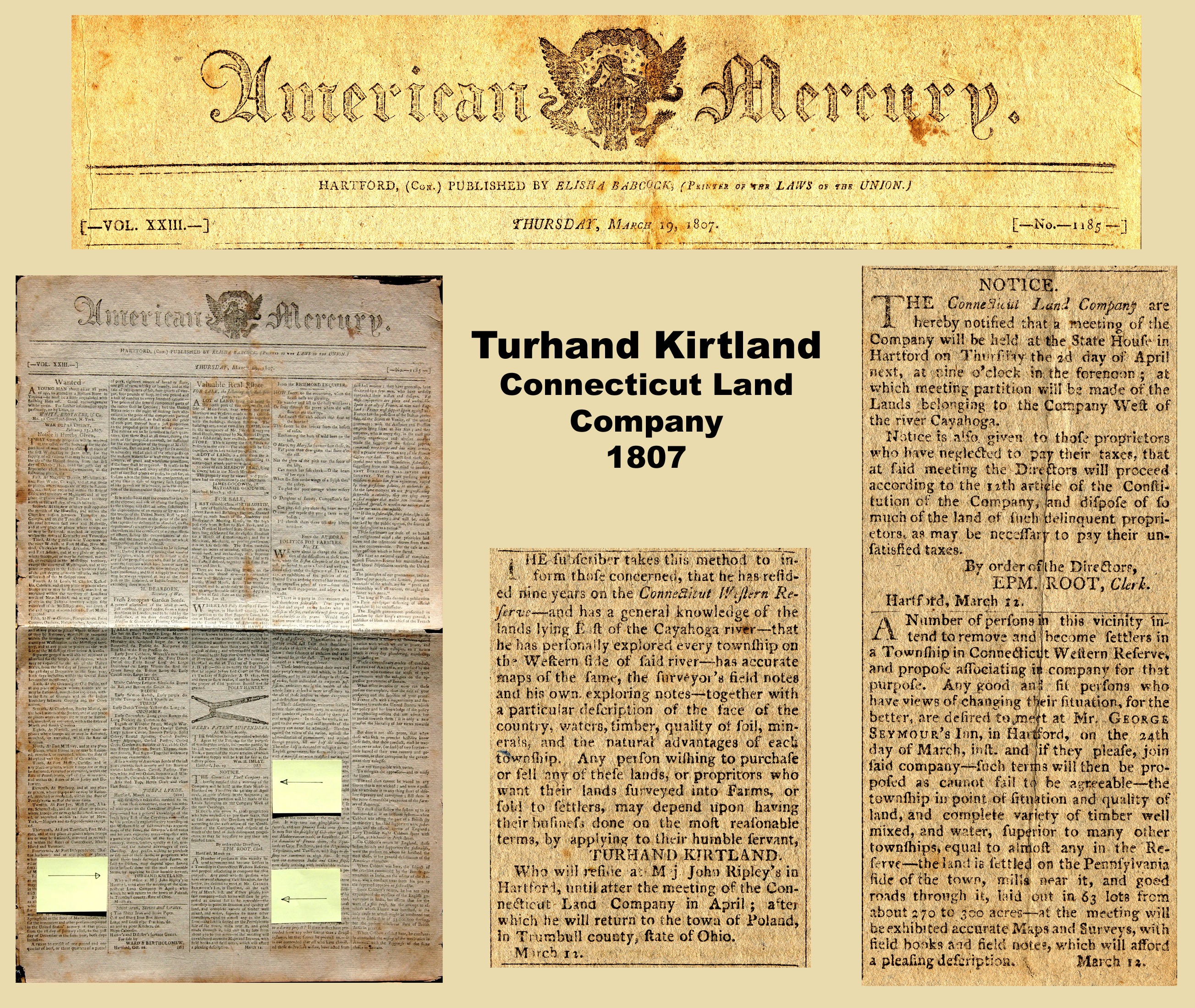
While Cleveland technically predates Poland as a settlement by a year or two and thus before Turhand became involved, Poland Township, as surveyed by Turhand Kirtland, has the distinction of being the first officially recognized township in the Western Reserve. Today Poland still prides itself as being designated "Township One, Range One", a surveyors designation for a Township with "one" representing the first of many. Over the next 4 years Turhand would spend about half the year in Wallingford and the other half in the Western Reserve. During this period he began the process of directing parties of surveyors in laying out the Western Reserve, it's Townships and it's early towns and roads. He also began selling land to the settlers who came in ever increasing numbers as towns and infrastructure were established to accommodate them. While history records that Turhand was the surveyor who laid out the Western Reserve, my research has uncovered nothing that suggest that Turhand had any specific training as a surveyor and his years as a successful carriage maker suggests that surveying wasn't his primary profession. I thus suspect that Turhand was probably more the manager of the surveying effort, perhaps learning as he went, and as such got the credit but did little of the actual surveying work which he supervised. A historical note: Among the many Townships that Turhand surveyed and sold land in was one that was named after him and which contained a town also bearing his name. Kirtland Township today officially no longer exists but the town of Kirtland remains northeast of Cleveland near lake Erie. In the 1830's the town of Kirtland became the temporary home for many members of the Mormon Church (Church of Latter Day Saints) and the town is now of major significance in the church's history. While named for him, Turhand never lived in Kirtland Township nor the town of Kirtland and, to the best of my knowledge, was never involved in any way with the Mormon Church. While in 1798 Turhand was the first to arrive at the location that would become Poland, OH, he isn't credited with being the village's first full time settler. That honor goes to Jonathan Fowler and his family who arrived a year later on May 29th, 1799. Jonathan was married to Turhand's sister Lydia Kirtland-Fowler and I think it possible that the Fowler family traveled west from Wallingford with Turhand that spring. It is said that the Fowlers camped out while they built a cabin. Jonathan Fowler would go on to run a local inn and build a flour mill in Poland in the early 1800's that stood until 1920. In 1803 Turhand brought most of his immediate family west and Poland became their new permanent home. They and their initial household possessions traveled west in two covered wagons through Pennsylvania and it's mountains. According to "Township One, Range One, Poland Ohio, Our Western Frontiers" (1996) Turhand's 37 year old brother Jared Kirtland (not to be confused with Turhand's son with the same name) came with him. (Brother Jared would in 1804 set up a tavern in the area.) I suspect that the Kirtland's also traveled west with other unrelated families heading to the Western Reserve to settle. The trip took a full month and the Kirtland family is said to have traveled with a hired man and several hired girls. Turhand, Polly and three children made the trip including Henry (age 8), Mary (age 5), and Nancy (age 2). The couple's eldest child, Jared Potter Kirtland (age 10 that year) stayed behind and lived with Polly's parents while he finished his education which would eventually included a degree from Yale. In 1823 son Jared would finally join his parents and siblings in Poland and would go on to become a very famous Ohio naturalist and physician among his many other accomplishments. The Kirtland family's early years in Poland would have included all the hardships that life on the frontier implies including the lack of the infrastructure and amenities they were accustomed to in Connecticut. But the area population was expanding extremely rapidly and over the coming years and decades would become well established. While Turhand primarily resided in Poland starting in 1803 he made frequent business trips back to Connecticut to conduct Connecticut Land Company business. Between 1799 when Jonathan Fowler was the first to settle in Poland Township and 1803 when Turhand and his family had moved there the number of individual landowners in the township had increased to 55. Poland and neighboring Youngstown would continue to grow rapidly due to their location as a gateway to the Western Reserve on the main road between Pittsburgh and Cleveland. In the early 2000's my brother Henry came upon a copy of the American Mercury (Hartford Connecticut) newspaper dated March 19, 1807 on an interned auction site. Since Turhand and the Connecticut Land Company were included in front page articles he promptly purchased it. Below is a composite of appropriate parts of the front page. The articles indicates that Turhand was in Hartford for the annual meeting of the Connecticut Land Company and is available to discuss the sale of land in the Western Reserve with any interested parties.
Front page of the March 19th 1807 edition of the American Mercury newspaper (Hartford, Connecticut).
Historical records indicate that, for a variety of reasons, the Connecticut Land Company went bankrupt and was dissolved in 1809. However, by this time Turhand was well established in the Western Reserve, most of the surveying work was likely done, and I suspect he would have kept selling land for the former company's individual investor land owners as well as land that he owned. He would have been someone that anyone interested in buying or selling land in the area would have wanted to talk to given his vast knowledge of the area. I've run into nothing which suggests how much land Turhand owned in the Western Reserve but it could have been substantial. One reference indicates that he owned 2,000 acres in Kirtland Township alone and this was only one of the townships in which he owned land. Another source says that he "owned a considerable amount of land in Poland" Township. Life In The Western Reserve
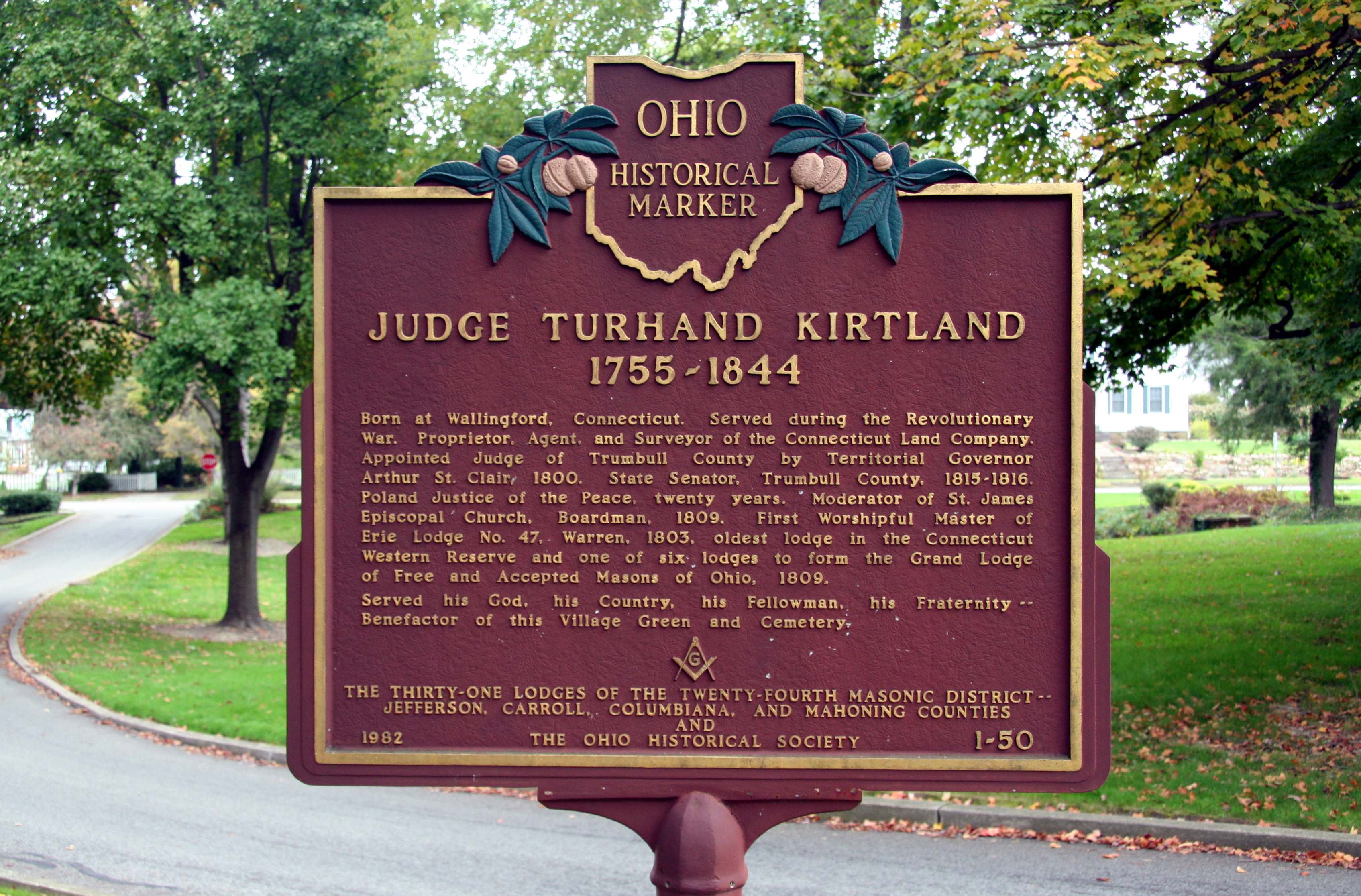
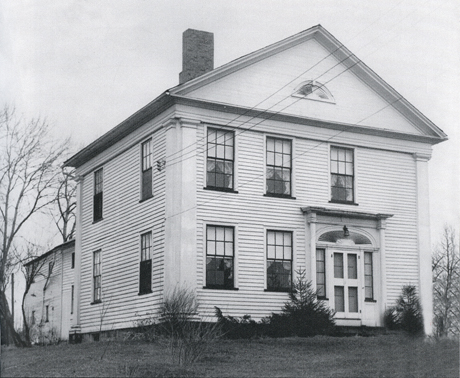
The Kirtland family's first home in the Western Reserve would have almost certainly have been of log cabin style construction however, as the area grew and settlers with craftsman's skills arrived and the infrastructure improved, Turhand would have surely upgraded the family home to one constructed to more modern East Coast standards. In "A Look At Poland, Ohio - 200 Years and Counting" by Robert Wilkeson (1996) the author wrote regarding the Kirtland's: "Their home was in the vicinity of the home now addressed as 424 South Main St. The property is next to the Presbyterian Church." Also, the "Guidebook to Historical Sites and Points of Interest In Poland, Ohio" states regarding the current home at 424 South Main Street: "The Hall-Walker-Powers House was built in 1850 in the Greek Revival style for Turhand Hall, oldest grandson of Turhand and Polly Kirtland. This property was likely the site of Turhand Kirtland's house, next to the Green." I've run into nothing that suggests that Turhand's home still exists. On the other hand there are multiple historic homes still in Poland that were built and/or occupied by Turhand's descendants. In 1800 Turhand was appointed Judge of Trumbull County by Territorial Governor Arthur St. Clair (apparently before he was even a full time resident.) Then in 1803, the year he established full time residency in Poland, and no doubt because of his previous active participation in Freemasonry in Wallingford, he was elected and installed as Master of Erie Lodge No. 47 in the nearby town of Warren, the first of many Masonic Lodges in the Western Reserve. He would remain an active Mason throughout the rest of his life.
In 1815 and 1816 Turhand served as a State Senator from Trumbull County. He was for several terms an Associate Judge for the Court of Common Pleas and for over 20 year was the Poland Justice of the Pease. Mary L.W. Morse wrote that Turhand "was one of the first to urge the necessity of a western college and he contributed most generously both in time and money to that institution which eventually became the Western Reserve College". Western Reserve College was founded in 1826 in the town of Hudson. Turhand was a founding trustee and in later years this institution would move to Cleveland and today is known as Case Western Reserve University.
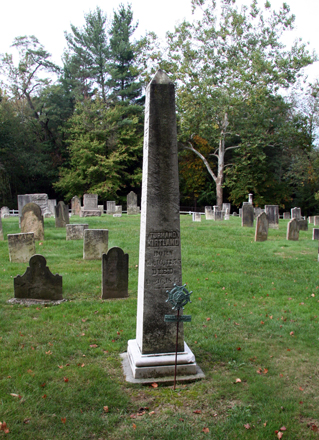
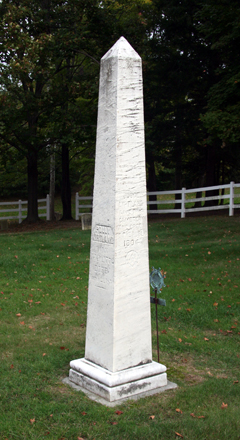
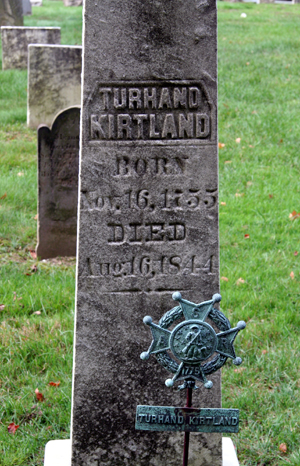
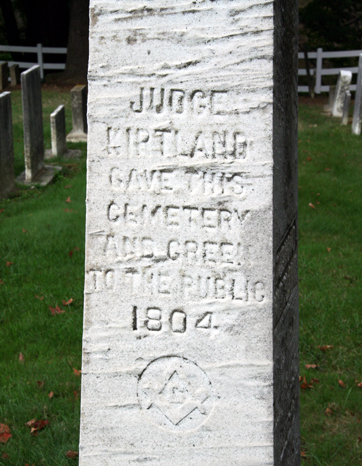
Final Resting Place
In addition to being prominent in the early development of the State of Ohio, the Kirtlands (including Turhand and Poly as well as Turhand's sister Lydia Kirtland-Fowler and brother Jared Kirtland who came with Turhand from Connecticut) left a legacy of many descendants in the area who would also go on to be prominent local citizens and contribute to the history of the once Connecticut Western Reserve.
Miscellaneous Family Stories and Anecdotes I've run into several stories which relate to Turhand and/or Polly.
"When visiting Cousin Lucy Boardman at 46 Hillhouse Ave. in New Haven Conn, I put on your great, great grandmother's wedding gown (Polly Potter). It was beautiful blue brocaded satin damask brought, I believe, from India. Julia Bishop, Isabel Kirtland Bishop's daughter, wore it as her wedding gown. Polly's portrait, in which she wore her wedding gown, is in Cousin Nell Hall's home." 'Cousin Lucy Boardman' was a granddaughter of Turhand and Polly's and Ellen Louise Hine's first cousin once removed. Julia Bishop was a 2nd great granddaughter of Turhand and Polly and Ellen Louise Hine's 2nd cousin once removed. 'Cousin Nell Hall' was Cornelia Wade Hall ("Nell"), a granddaughter of Turhand and Polly and Ellen Louise Hine's second cousin. This short anecdote suggests several things. First, that Polly Potter-Kirtland's wedding dress from 1793 In Wallingford, CT remained intact and functional for well over 100 years. While I don't show a birth or wedding date for Julia Bishop, her mother Isabel Kirtland-Bishop was born in 1879 suggesting that Julia was not likely married till well into the early 1900's. Second, I find it interesting that a portrait of Polly survived. Cornelia W. Hall spent most of her life living in Warren, OH (not far from Poland) and passed away in 1954. She never married and thus had no children to pass the portrait on to so I can only guess (hope) that it made it's way into a museum or historical society. I'd love to know it's whereabouts.
From "Guidebook to Historical Sites and
Points of Interest In Poland, Ohio" regarding the home currently at 424 South
Main Street in Poland, OH (believed to be the location of Turhand and Polly's
home):
The following paragraph is from the childhood recollections of Ruthanna Anderson-Clark (1899-1985), Turhand and Polly's 2nd great granddaughter and was provided to me by her daughter Joanna Clark-Moore (my 3rd cousin). Ruthanna had, in the early 1900's as a young child visited Poland , Ohio and stayed there for a time with her grandmother Lucy Kirtland-Mays (grand daughter of Turhand and Polly). Ruthanna recalls as follows: "Turhand and his descendants [respected] the local Indians. He also brought from New England a black man whom he freed and gave him land from his grant. When I was in Poland the black family of Alfred Arnold was still in Poland. He was chief of police then. The family moved to Youngstown because the young people in the family could find no black mates." This statement possibly suggests that Turhand may have owned a slave. I've run into no other suggestion that this was the case and slavery wasn't common in Connecticut, so perhaps this generational recollection refers simply to a hired hand that accompanied the Kirtlands to Ohio and who was paid partly with land.
Some Source Material
The Riverside Review In the early 2000's Poland, OH area historian Ted Heineman
included a number of pages regarding Turhand Kirtland and related
historical information in his monthly publication titled The Riverside Review.
I've included excerpts
regarding Turhand and some of my other Ohio Hine and Kirtland
ancestors here:
|
||||||||||||||||||||||||||||||||||||||||||